I started this blog in 2012, just after I left the comforting embrace of a postgraduate study room and disappeared to Devon to write up my thesis.
It has seen me through my first job, my first publications, my first child, and a whole load of other valuable and life changing experiences.
It's been a great space to write and think and share.
But I think I've outgrown it. It feels clunky, it looks dated, and it no longer meets my needs. (The same could sometimes be said of my body, but I'm letting that off the hook after completing a triathlon at the weekend, in spite of my atrocious pelvic floors). God knows, I abandoned the "Pots, Places, Stones, Bones" premise years ago. A new place to talk to the internet is definitely required.
So, I have built it, now I'd like you to come on over there.
My new blog is lucyshipleywritesthepast.wordpress.com
I hope you like it. Thanks for all the comments, thoughts, views, engagements we've shared here. I hope we'll keep on sharing them.
PS- I'm leaving this blog live as an archive, a diary, a memory. There'll be a link here from the shiny new site. Some of these posts were too much fun to get rid of.
Wednesday, 6 July 2016

Wednesday, 22 June 2016
A Safe Space
It's been an emotional evening. It's the eve of the EU Referendum, which has unleashed forces of misogyny and xenophobia that have ended in murder. I fully support giving the people the right to decide, but turning over this particular stone has had consequences I (naively) didn't predict. There have also been some particularly awful news stories that have had an impact on me - the murder of children in Syria and right here in the UK. Tonight I've been reading the experiences of women having the most terrible experiences which made me so full of anger and sadness (and confirmed all my feelings about being 100% pro-choice).
And all this sturm und drang has coincided with the beginning of digging season: my social media feeds are flooded with friends returning to the most beautiful Tuscan village where, although bad things certainly happened when I was there, my memory provides a warped vision of golden summers filled with friends and the joy of science and discovery. My friend Theresa just wrote the most lovely piece on the FOMO (Fear Of Missing Out) caused by not being there.
I wonder if the real reason I grieve for not spending 8 weeks digging in Italy this summer is not the high of excavation, or the high jinks of celebrations/commisserations. I don't think it's the food, wine or views that I'm really missing. I think it's the entirely false impression that in that enchanted place, in this safe space, there are no problems that our wonderful excavation director can't work out, and that can't be forgotten with a little grappa, a hug and a late night conversation with a good friend.
I think that's a testament to the site and its running, and I'm sure that experience was not universal: I certainly saw people battle with homesickness, personal issues, relationships and grief. Nostalgia is a false friend. But those summers were before I really saw Etruscan archaeology with the gloves off at a hostile, sexist conference, before I lost a pregnancy and came damn near losing another one, back when I had a funded PhD position and an engagement ring and was sure that the world would be a feast of opportunities and joys.
Those experiences are the reason it doesn't feel the same when I go back, the reason the FOMO bites me personally so hard.
As with everything in archaeology, the major issue is I can't go back in time.
And all this sturm und drang has coincided with the beginning of digging season: my social media feeds are flooded with friends returning to the most beautiful Tuscan village where, although bad things certainly happened when I was there, my memory provides a warped vision of golden summers filled with friends and the joy of science and discovery. My friend Theresa just wrote the most lovely piece on the FOMO (Fear Of Missing Out) caused by not being there.
I wonder if the real reason I grieve for not spending 8 weeks digging in Italy this summer is not the high of excavation, or the high jinks of celebrations/commisserations. I don't think it's the food, wine or views that I'm really missing. I think it's the entirely false impression that in that enchanted place, in this safe space, there are no problems that our wonderful excavation director can't work out, and that can't be forgotten with a little grappa, a hug and a late night conversation with a good friend.
I think that's a testament to the site and its running, and I'm sure that experience was not universal: I certainly saw people battle with homesickness, personal issues, relationships and grief. Nostalgia is a false friend. But those summers were before I really saw Etruscan archaeology with the gloves off at a hostile, sexist conference, before I lost a pregnancy and came damn near losing another one, back when I had a funded PhD position and an engagement ring and was sure that the world would be a feast of opportunities and joys.
Those experiences are the reason it doesn't feel the same when I go back, the reason the FOMO bites me personally so hard.
As with everything in archaeology, the major issue is I can't go back in time.
Monday, 2 May 2016
Teaching Trigger Warnings
 |
| Image: wikimedia commons |
Trigger warning: this post will contain some upsetting descriptions of other people's life experiences.
That's one sentence- are you going to stop reading? There's been a bit of scrapping on Twitter and elsewhere recently about using trigger warnings in university teaching. One academic I deeply respect argued convincingly that she does not and will not use them in her practice: she sees them as alienating students from the realities of the world, and pointed out that so much of her teaching is centred on disturbing events she would need to issue a trigger warning every week.
However, looking back, I do think I should have used trigger warnings in my teaching. If and when I am lucky enough to get my hands on more innocent undergraduate minds, I will make sure to do this. And this is why.
I taught a course that was designed to blow open those first year undergraduate minds- Social and Cultural Anthropology for Archaeologists. We (my brilliant co-lecturer and I) tried hard to get everyone thinking about their own ethnocentricity- their rootedness in a particular culture - and the way this affects archaeological interpretation. By exploring both the theoretical underpinnings and fascinating case studies of social anthropology, we tried to show the infinite variety and meaning in human behaviour. I hope our students enjoyed the experience.
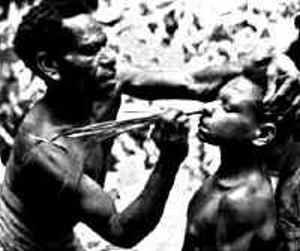
BUT, one lecture in particular could have been deeply distressing for some students, and I'm ashamed that I never thought of this until recently. For this week of work, we looked at sexuality, and our case study was Gilbert Herdt's work with the Sambia people of Papua New Guinea. Among the Sambia, the only way for a boy to become a man is for him to ingest semen, which he receives orally from older men. The young boys are also toughened up with beatings, and ritual nosebleedings (shown in the picture at the top). Our point (linked to Mary Weismantel's brilliant paper on Moche pots) was that you cannot define easily what is sexual, and what is abuse. From a Sambia perspective, one could argue that Western boys are abused as they can never fully become men. There is also an uncomfortable argument to engage with about abstract concepts of morality, and respecting indigenous practice vs feeling pity for the children involved. The lecture never failed to spark debate and get people questioning themselves, which was our hope.
AND YET. What if someone in the room had been sexually abused as a child? Beaten and forced to perform fellatio? How profoundly distressing and uncomfortable the experience of learning about the Sambia would be, what dreadful memories could have been dredged up, what damage could we have done as lecturers where we had hoped to inspire?
So, in short, we needed to let students know what was coming. We needed a trigger warning. With that session in mind, I think I'll always be more aware of this in my teaching. For the sake of a single sentence, it's better to avoid a lecture with potentially disastrous consequences.
Wednesday, 27 April 2016
#MisCourage and telling the whole truth
It's all gone a bit quiet from me recently- not been on Twitter much, been rubbish at replying to emails, not been banging on about archaeology online, not done much writing since coming back from Ireland.
This could just be a natural reaction to the intensity of a Visiting Fellowship, a joyful time which was stuffed to the gunnels with work.
Sadly, that's not what the problem was. The problem was that last Friday I was diagnosed with an ectopic pregnancy and have since been going through the process of my body disposing of this poor little misplaced bundle of cells. It's not been much fun. In fact, there was a point on Friday when it looked like I would be in surgery that afternoon. I can't say how thankful I am that this didn't happen and my body has dealt with it without intervention. I'm definitely one of the lucky ones.
I've read other brave posts from scholars writing about how their ongoing conditions have affected their work- what comes across most is their strength to carry on in spite of long term pain. I don't know quite how to explain my own sudden absence except in these brutally honest terms: I've had bigger things to worry about than Etruscans, publications, and even Twitter, like potentially losing a Fallopian tube and leaving my daughter overnight while she is still getting over being separated in Ireland.
Tommy's, a charity that supports families who suffer pregnancy loss and stillbirth, have started a campaign called #MisCourage that encourages people to share their experiences, start a conversation, acknowledge that this happens: it's not all happy endings and cute scan pictures. For some of us, what starts with a joyful little line on a stick ends with tears and tests and ultra towels.
I wanted to join in, to explain, to state what has happened in the last week. But I do feel afraid- is this appropriate, is this too much information, is this really ok for a blog that is deeply tied to my academic identity? But the two things go together- if you've been wondering where I've been, now you know. Is it better to be perceived as an oversharer or a flake?
I'm going with it's better to tell the truth.
This could just be a natural reaction to the intensity of a Visiting Fellowship, a joyful time which was stuffed to the gunnels with work.
Sadly, that's not what the problem was. The problem was that last Friday I was diagnosed with an ectopic pregnancy and have since been going through the process of my body disposing of this poor little misplaced bundle of cells. It's not been much fun. In fact, there was a point on Friday when it looked like I would be in surgery that afternoon. I can't say how thankful I am that this didn't happen and my body has dealt with it without intervention. I'm definitely one of the lucky ones.
I've read other brave posts from scholars writing about how their ongoing conditions have affected their work- what comes across most is their strength to carry on in spite of long term pain. I don't know quite how to explain my own sudden absence except in these brutally honest terms: I've had bigger things to worry about than Etruscans, publications, and even Twitter, like potentially losing a Fallopian tube and leaving my daughter overnight while she is still getting over being separated in Ireland.
Tommy's, a charity that supports families who suffer pregnancy loss and stillbirth, have started a campaign called #MisCourage that encourages people to share their experiences, start a conversation, acknowledge that this happens: it's not all happy endings and cute scan pictures. For some of us, what starts with a joyful little line on a stick ends with tears and tests and ultra towels.
I wanted to join in, to explain, to state what has happened in the last week. But I do feel afraid- is this appropriate, is this too much information, is this really ok for a blog that is deeply tied to my academic identity? But the two things go together- if you've been wondering where I've been, now you know. Is it better to be perceived as an oversharer or a flake?
I'm going with it's better to tell the truth.
Monday, 11 April 2016
Saying stupid stuff on the Internet
Recently I've had a couple of Twitter booboos.
The first one was not too bad, I thought someone was critiqueing someone else in a sarcastic way and tried to join is as I like this person and respect their work. They were being serious. I felt like an utter tool. Luckily this person is as kind and generous as they are a good scholar and was very magnanimous about my idiocy. I resolved not to go on Twitter in the early morning when extremely tired after a night of battling Silvia.
The second time, I had no such excuse. I'd been at work here at NUIG all day, my brain was fully in gear. But I just saw a single retweet and went off like a rocket, soaring into an interpretative universe all my own. It was an RT of someone live tweeting a paper on Roman breast pumps and (having been tortured by the damn things myself) I was instantly going off into a world of experiential archaeology, the significance of being able to effectively relieve your own engorgement pain (it is as bad as it sounds folks), the need for such relief if elite Roman women were giving their babies to wet nurses etc etc. Except that the objects in question weren't breast pumps at all, and that was the whole point of the paper. DOH!
I normally try to be quite careful about what I post online: after all, it's a reflection of me and I like to think that I'm as kind and thoughtful a human being on t'Internet as I try to be in life. When it's clear you've been an idiot, however, how can you respond?
In both cases, I've responded with apologies and corrections, tried to make myself the butt of the joke. I don't know if this is the right response. I'm still worried about both situations, about future possible idiocies. Maybe this is my David Clarke social media moment, Lucy's online archaeology's loss of innocence?
Anyway, let me know if you've got good ways to a) avoid being a fool online b) minimise the effects of that foolishness. Oh, and if you've seen me be an idiot online, tell me please.
The first one was not too bad, I thought someone was critiqueing someone else in a sarcastic way and tried to join is as I like this person and respect their work. They were being serious. I felt like an utter tool. Luckily this person is as kind and generous as they are a good scholar and was very magnanimous about my idiocy. I resolved not to go on Twitter in the early morning when extremely tired after a night of battling Silvia.
The second time, I had no such excuse. I'd been at work here at NUIG all day, my brain was fully in gear. But I just saw a single retweet and went off like a rocket, soaring into an interpretative universe all my own. It was an RT of someone live tweeting a paper on Roman breast pumps and (having been tortured by the damn things myself) I was instantly going off into a world of experiential archaeology, the significance of being able to effectively relieve your own engorgement pain (it is as bad as it sounds folks), the need for such relief if elite Roman women were giving their babies to wet nurses etc etc. Except that the objects in question weren't breast pumps at all, and that was the whole point of the paper. DOH!
I normally try to be quite careful about what I post online: after all, it's a reflection of me and I like to think that I'm as kind and thoughtful a human being on t'Internet as I try to be in life. When it's clear you've been an idiot, however, how can you respond?
In both cases, I've responded with apologies and corrections, tried to make myself the butt of the joke. I don't know if this is the right response. I'm still worried about both situations, about future possible idiocies. Maybe this is my David Clarke social media moment, Lucy's online archaeology's loss of innocence?
Anyway, let me know if you've got good ways to a) avoid being a fool online b) minimise the effects of that foolishness. Oh, and if you've seen me be an idiot online, tell me please.
Wednesday, 6 April 2016
The researcher wants a wife...

The researcher wants a wife, the researcher wants a wife, ee ii the adio the researcher wants a wife.
Wife wanted. 1950s style preferred. Satisfaction its own reward, no stipend. You will need to take care of my child full time while I work, be prepared to pick up and move to a new city every 2-3 years for the next 10, keep on top of the lion's share of the housework, do any and all childcare in a strange place while I'm on fieldwork. You certainly won't have time for your own career as I will need all your time to support my own. Oh, and any kids will need to be 100% adaptable to my sudden disappearances and continual new houses and schools.
I'm in Galway, and for the next two weeks I do have a wife (of sorts) as my husband (keep up!) has taken precious annual leave to take care of our daughter while I enjoy the absolute luxury of space to time, think and write here on a Visiting Fellowship.
Our daughter, while coping brilliantly with being with Daddy in the daytime (and my parents for the previous week- thanks Mum and Dad) is clingy and sad at night, and wants to be with me almost continually, waking every two hours. I am, as a result, just a bit tired.
If I had a wife, she would be the primary carer and Silvie would be fine. I wouldn't have to make this wife take Annual Leave. Applying for a post-doc to come back here full time wouldn't be a source of worry and nervousness, it would be an exciting prospect as said wife would just get on with her homely tasks and settle the baby in for me.
Seeing as how no 1950s housewife/free of charge Mary Poppins figure is going to show up and sort this issue out, I'm going to have to keep on juggling, and enjoy the short term time for my own work.
Yet I can't help feeling that the structure of research careers: characterised by prestigious international fellowships, national relocations, and short term contracts, is inherently biased against people with families- men and women.
These posts are underwritten by other people doing the domestic labour - a kind of labour that has traditionally been highly gendered. But in the modern world, your spouse (male or female) is highly unlikely to be a full time domestic god(dess) who can just pack up their hoover and the nappies and move wherever you need to go next.
I don't know what the solution is, but I'm going with just applying for everything and hoping that things fall into place. But if you'd like to be my 1950s wife, get in touch.
Saturday, 30 January 2016
I said it, and I meant it
So I deleted my academia.edu account.
I've been perturbed by academia.edu for some time now. I couldn't quite put my finger on what I disliked about the site- but I think it was probably a nagging question of why embrace a series of unforced performance metrics when your life is already filled by the damn things? Sure, it's fun to see how many views a paper gets, and how many your profile gets (wow, someone in Argentina looked at my profile etc) but do you really need to know this? How much is vanity, and how much is career obsession? Are either of those two things healthy?
I still did it though. The old (and deep) fear of your career suffering as a result of not playing the game won out.
But the recent revelations that academia.edu staff have been contacting scholars and asking them to consider paying for their papers to be promoted by senior staff has revealed a lot about the site, in my eyes at least.
And, in common with lots of other scholars, I'm no longer happy to affiliate with the site. So, I've pulled my profile down.
If you want to read my work, go for it! If you want to get in touch, please do. I'd love to hear from anyone about collaboration or feedback or anything. I just don't want to have those conversations through a medium that seeks to profit from a desperate desire for career progression, and that is willing to swap endorsements for cash.
I've been perturbed by academia.edu for some time now. I couldn't quite put my finger on what I disliked about the site- but I think it was probably a nagging question of why embrace a series of unforced performance metrics when your life is already filled by the damn things? Sure, it's fun to see how many views a paper gets, and how many your profile gets (wow, someone in Argentina looked at my profile etc) but do you really need to know this? How much is vanity, and how much is career obsession? Are either of those two things healthy?
I still did it though. The old (and deep) fear of your career suffering as a result of not playing the game won out.
But the recent revelations that academia.edu staff have been contacting scholars and asking them to consider paying for their papers to be promoted by senior staff has revealed a lot about the site, in my eyes at least.
And, in common with lots of other scholars, I'm no longer happy to affiliate with the site. So, I've pulled my profile down.
If you want to read my work, go for it! If you want to get in touch, please do. I'd love to hear from anyone about collaboration or feedback or anything. I just don't want to have those conversations through a medium that seeks to profit from a desperate desire for career progression, and that is willing to swap endorsements for cash.
Monday, 18 January 2016
Grand Challenges Part II: This time, it's personal
 |
| Yes, I'll be back, Clonmacnoise. |
So, as promised, here is the second half of my little chunk of the wonderful Doug's Archaeology 2016 blogging carnival.
First, some news: I have resigned from my job at Andante Travels- yes, the dream job designing wonderful archaeological holidays. In so many ways it was perfect, supportive company, great colleagues, opening up the past to the general public. But I couldn't make it work with a 10 month old and a 90 minute commute. So, that's that.
What happens now?* Well, I'm delighted to say I've been offered a Moore Institute Visiting Fellowship at National University of Ireland, Galway. I'll be there from late March to mid-April, made possible by my parents and husband taking time out to look after Silvia. I'm excited about it, and about the work I'll be doing, as well as the people I'll be working with. Any suggestions for cool things to do in Galway with a toddler much appreciated.
 |
| I hope the weather in Galway is this good again, or husband will suffer with a cooped up Silvia! |
 |
| Her challenge is to walk under the Boccanera Plaques, not crawl. FYI, the Etruscan gallery of the British Museum is an excellent place for your baby- the case arrangements are a perfect crawling speedway. |
The day-to-day of this is not a problem, keeping the balls in the air- you just do it. She wouldn't sleep last night, so instead of doing my usual 8-11 writing stint, it was 10-1. Then she woke at 3. And 5. Not great, but fine. I'm awake and alert. Just.
Coming to the point at last, my own grand challenge is to carve out a meaningful space for this new woman-in-archaeology-but-also-in-motherhood self. It would be wonderful to be able to link this with a formal position, but if the applications gods are unkind, I need to find a way to be ok with that. To write, to think, to be an archaeologist. Inside or outside the academy**. And I need to fit that with my family.
Doddle, right?
Ha.
Disclaimer: I AM INCREDIBLY AWARE OF HOW PRIVILEGED I AM TO BE ABLE TO TAKE THIS TIME AND HAVE THIS SPACE TO THINK AT ALL. Just saying. Also, it's a neat little feminist juxtaposition that embracing total dependence on my husband (and the vast majority of housework/childcare) allows me to think and work, albeit not for pay. Hmmm.
*Well, my first commitment that I'm so pleased to be doing is at the Institute of Classical Studies in London on the 9th February. Come along for some Derrida, some Corpus Vasorum Antiquorum, and to hear the results of that survey I've been plugging on Twitter. What's not to like?
**Another post needed here on the new independent scholar, I think. With the current over-production of PhDs, we could be a veritable army.
Thursday, 7 January 2016
Blogging Carnival : Grand Challenges
 |
| Ominously, this appears when you google image search Etruscan challenge. Ouch. It's Charun, Etruscan death demon, supervising the death of a bound captive. Cheerful stuff. |
So, in the past I've taken part in the fab Doug Rocks-Macqueen's Archaeology Blogging Carnival, and I'll be doing it this year too. Two posts on this year's theme are coming right up.
And what a theme it is. Grand Challenges of Archaeology. The question is, what are the Grand Challenges of YOUR archaeology?
Well, to me MY archaeology is my own personal archaeological journey (vomit vomit x-factor language) and Etruscan archaeology (my preciousssssss, in best Gollum voice).
So this post is about the Grand Challenges of Etruscan archaeology, or rather, THE Grand Challenge as I see it.
And (drumroll please), I think the challenge of Etruscan archaeology is....
The production of new archaeological narratives for Etruscan people's lives.
We really, desperately, need to come up with and share new interpretations of the Etruscan past. Time and again, in the past few years, we have seen remarkable developments in Etruscan archaeology. New discoveries of tombs barely damaged or even untouched by tomb robbers, new data coming out untainted by antiquarian excavation techniques. We also have incredible scientific advances: an intricate and carefully controlled study of Etruscan DNA which, for the first time, has some real answers of where these people came from and who they were. At the Milan Expo, Etruscan scholars shared their work through new digital technologies, bringing the Etruscans to a wider audience through 3D reconstructions.
Yet some very familiar stories are still kicking around, in and among (and in spite of) these new discoveries, methods and opportunities. The idea of the Etruscans as mysterious and unknowable, a frustrating mirage which obscures these wonderful leaps forward. The idea of princely tombs, linked to monarchial systems of government I've critiqued here before, a conception of Etruscan life which is more akin to a child's tale of princes and princesses than it is to a real evaluation of these people's life stories. These are old ideas with a venerable heritage- we can understand where they came from and why they are compelling. They continue to capture the imagination.
In my opinion though, these ideas are no longer an acceptable option for the Etruscological community, and to me it is wrong for us to continue to parrot them to the general public. It is almost ten years since Vedia Izzet (the person responsible for letting me loose on the unsuspecting Etruscans) wrote her seminal text critiquing these interpretative tropes. In that decade, little has changed. Her words remain as cogent now as they were on the day they were written. Perhaps, in the year before the ten year anniversary of its publication, the stories we tell as Etruscan archaeologists might change- we can look again at our data, new and old. We can experiment with ideas from anthropology and philsophy. We can think ourselves a new version of the Etruscan past, using objects and ideas. In this way, we might just be able to catch up with the excavations, the genetics, the technology. That is our grand challenge.
** There are signs that the challenge is being accepted- I'm very excited about a new journal in Italian archaeology, Ex Novo. It's open access and explicitly theoretical- a brave new voice. I have high hopes.**
Saturday, 2 January 2016
Back and bad... and bibliographies
Well, that was a nice break.
Christmas with a small child suddenly has purpose again. Magic, and a little smile on a little face, and trying not to let her pull the Christmas tree over. Watching her scoff down Turkey and her eyes light up at the first taste of chocolate pudding (and last for a while- she's back on fruit for pudding).
Also, and more importantly, Christmas equals husband off work which means lots of time for writing/editing.
And the resulting discovery has been fascinating. Turns out, I couldn't write for toffee in the final stages of pregnancy. I read all the chapters in one day, and was really not happy with the first couple. Then, boom! Chapter three, and back on form.Well, as close to form as I get (insert crippling British sense of self worth here).
How fascinating- I'm not sure why? Maybe the hormones. Maybe the poor sleep. Maybe the worry of impending life change and you know, the whole labour thing. And the whole having responsibility for a tiny human thing.
Yet, once the tiny human was here and napping, my brain suddenly worked again, or at least, so it seems. I'm editing well into chapter 4, and it really isn't as bad as I had feared when I started.
But what the writing gods give, they also take away. Because I'm only now realising how dire the footnote organisation situation is. In a popular archaeology book, what's the best way to reference? Obviously, Harvard is out. Footnotes at the bottom of each page are impractical. The only answer seems to be a series of end-notes, divided by chapter. That's what my favourite authors do. But then the bibliographic information is so divorced from what I'm using it to argue that it feels clandestine, naughty. I guess it's still there. A reader can find it. I suspect my editors will have the final call.
So, any thoughts? On writing-while-pregnant, or on bibliographic behaviour?
Christmas with a small child suddenly has purpose again. Magic, and a little smile on a little face, and trying not to let her pull the Christmas tree over. Watching her scoff down Turkey and her eyes light up at the first taste of chocolate pudding (and last for a while- she's back on fruit for pudding).
Also, and more importantly, Christmas equals husband off work which means lots of time for writing/editing.
And the resulting discovery has been fascinating. Turns out, I couldn't write for toffee in the final stages of pregnancy. I read all the chapters in one day, and was really not happy with the first couple. Then, boom! Chapter three, and back on form.Well, as close to form as I get (insert crippling British sense of self worth here).
How fascinating- I'm not sure why? Maybe the hormones. Maybe the poor sleep. Maybe the worry of impending life change and you know, the whole labour thing. And the whole having responsibility for a tiny human thing.
Yet, once the tiny human was here and napping, my brain suddenly worked again, or at least, so it seems. I'm editing well into chapter 4, and it really isn't as bad as I had feared when I started.
But what the writing gods give, they also take away. Because I'm only now realising how dire the footnote organisation situation is. In a popular archaeology book, what's the best way to reference? Obviously, Harvard is out. Footnotes at the bottom of each page are impractical. The only answer seems to be a series of end-notes, divided by chapter. That's what my favourite authors do. But then the bibliographic information is so divorced from what I'm using it to argue that it feels clandestine, naughty. I guess it's still there. A reader can find it. I suspect my editors will have the final call.
So, any thoughts? On writing-while-pregnant, or on bibliographic behaviour?
Tuesday, 10 November 2015
Flipping First Drafts
So, I have (finally, tonight, at 10:12pm) finished the first draft of Book the Second.
It's a snip at 57,000 words, excluding footnotes and references and acknowledgements and all the grown up caboodle. It's not huge, not by any means. But it's still over what the commissioning editor asked for- so a good chunk is going to have to go.
I cannot wait to attack it, pull it to bits, and rebuild it. I can already feel things wrong with it that are burning and itching in my brain, like little fleas determined to irritate me and suck out my writing flow. The last chapter was a struggle and a half as the editing fleas grew and swelled, becoming louder and more insistent.
The last time I finished something like this it was the first draft of my PhD, and there were no such issues. I was smug, happy and confident. My lovely supervisor would tell me where I had gone wrong and where to fix it, but it was done. To be fair, that was at least 20,000 words longer, so maybe I'd gone further into the dark place where your own work is the only thing you see. I'm hoping that the fact I can tell it needs editing, and major editing at that, is a sign that maybe I've grown up a bit since then. That I can even tell what those edits should be, that I can see where I want to shift and change and delete and grow, is giving me a sliver of hope for the future of the volume.
This must be what being a grown up feels like.
BUT wait, stop. Space. The essential ingredient, not the final frontier. I will not open any of the individual chapter word documents until December. I will not. I will let them lie fallow, turn my face to other ideas (of which more soon). Edit too fast, and edit too floppily.
Then, what? My usual plan of attack is print the whole thing out and attack it- see where it flows and where it sticks. Make a list of the instinctive problems, make a list of repetitive bits. Highlight words in paragraphs that you use too much (past culprits include "beautiful" "materials" and "striking." Moi?). Check your facts, then check them again. Same goes for references.
Then, to the victims. If you want to be a reader, let me know. You might get off lightly, with a chapter. You might be the poor schmuck who asks for the whole thing and receives it in the dark of a January night.
But, before your impending doom, any magical tips to turn a first draft into a second draft?
It's a snip at 57,000 words, excluding footnotes and references and acknowledgements and all the grown up caboodle. It's not huge, not by any means. But it's still over what the commissioning editor asked for- so a good chunk is going to have to go.
I cannot wait to attack it, pull it to bits, and rebuild it. I can already feel things wrong with it that are burning and itching in my brain, like little fleas determined to irritate me and suck out my writing flow. The last chapter was a struggle and a half as the editing fleas grew and swelled, becoming louder and more insistent.
The last time I finished something like this it was the first draft of my PhD, and there were no such issues. I was smug, happy and confident. My lovely supervisor would tell me where I had gone wrong and where to fix it, but it was done. To be fair, that was at least 20,000 words longer, so maybe I'd gone further into the dark place where your own work is the only thing you see. I'm hoping that the fact I can tell it needs editing, and major editing at that, is a sign that maybe I've grown up a bit since then. That I can even tell what those edits should be, that I can see where I want to shift and change and delete and grow, is giving me a sliver of hope for the future of the volume.
This must be what being a grown up feels like.
BUT wait, stop. Space. The essential ingredient, not the final frontier. I will not open any of the individual chapter word documents until December. I will not. I will let them lie fallow, turn my face to other ideas (of which more soon). Edit too fast, and edit too floppily.
Then, what? My usual plan of attack is print the whole thing out and attack it- see where it flows and where it sticks. Make a list of the instinctive problems, make a list of repetitive bits. Highlight words in paragraphs that you use too much (past culprits include "beautiful" "materials" and "striking." Moi?). Check your facts, then check them again. Same goes for references.
Then, to the victims. If you want to be a reader, let me know. You might get off lightly, with a chapter. You might be the poor schmuck who asks for the whole thing and receives it in the dark of a January night.
But, before your impending doom, any magical tips to turn a first draft into a second draft?
Wednesday, 14 October 2015
Sunday Supplement Etruscans
 |
| Image (c) The Sunday Times. |
Yeah, I know. It's Wednesday, not Sunday.
But very unusually, I got my grubby mitts on a Sunday paper. We don't normally bother- pre-baby we felt like they were expensive and luxurious, so would get them very occasionally. Post-baby, we don't have time. My parents were here, and they looove their big Sunday broadsheet, so palming Silvia off on her father, I leafed through the different bits of the Sunday Times. And there, in the telly guide, was a reference to the Etruscans! Unfortunately, it was in relation to a really poor piece of archaeo-tv, a programme on the Celts that has been so comprehensively reviewed by the excellent Rachel Pope that I won't go into its faults (and there were many) here.
The TV critic, A.A. Gill, broadly shared Rachel's opinion of the Celts programme. He divined that the Celts were really a made-up people (a somewhat fair point, considering the machinations of 19th century cultural historians) and that the whole show was trying to overcompensate for that fact, cobbling together a tight historical narrative based on Roman texts, instead of exploring the complex interrelationships of these different communities across Iron Age Europe*.
But he had to go and drag the Etruscans into it, didn't he? I've recycled the damn magazine now (foolishly), but the gist was that the Celts were a made up people "like the Etruscans." Well. Well now. Who'd have thought I'd wasted so many years of my life studying a figment of the 19th century imagination, stirred up from Roman texts?
Well, big sigh of relief all round, I definitely haven't. The idea of an Etruscan people is right there in their own words. The term "Rasna" or "Rasenna" is used to refer to a collective group of central Italian communities who chose to define themselves with this word. It's thought to mean "people of the city," so the Etruscans are stating the centrality of urban living to their self-identification. It's central to who these people thought they were. It's (perhaps) what made them different from their neighbours, across the Appennines and to the south. So, Mr Gill, even if you are unhappy with stylistic attributions that stick art styles to archaeology and then to supposed ethnic groups, here is a group of ancient people who were quite happy to define themselves as different from their neighbours. Leave the Etruscans out of it, please. We have quite enough problems of our own to deal with in promoting Etruscan archaeology without everyone thinking the whole thing was made up.
In fact, help a sister out. ***Brazen publicity request/plug alert*** Can we please have a feature on the Etruscans in the Sunday Times Culture section, perhaps when my new book comes out? Let's talk.
*In a massive and simplified aside, why are we still so scared to admit that on occasion the Romans were wrong? The ever-brilliant Mary Beard (who Gill has been deeply, misogynistically unpleasant to in the past) was opining in the same Culture section of the same paper that the Romans are really terrifically overrated. And that's from a classicist! Come on people (especially commissioners of archaeological TV), let's break free of two millennia of Roman intellectual oppression. Digression over.
** In the magazine of the Sunday Times, Mr Gill was back with a review of what sounded like an atrocious and very expensive restaurant in London. He made a reference to "if Lidl did an own brand French fish soup." Mr Gill, they do- I tried it last night, and it's not half bad- tasted ok, no nasty after effects and cheap as chips. I suggest you give it a go, it was far nicer than the bouillabaisse you described forcing down in the review.
Monday, 5 October 2015
Telly Special: Questions and Queens
Secret History is back on Channel 4, and it's been a while since I blogged about archaeology on the telly, so I thought I'd share some thoughts on the first two episodes.
I want to start with last night, probably the more tricksy of the two shows so far. The hook was Cleopatra, and the film focused on the single minded quest of an amateur archaeologist to find her lost tomb. It was clear that the lady in question, Kathleen Martinez Berry, was living out her Indiana Jones fantasies, and fair play to her- through her stubborn refusal to give in, her bright optimism in the face of snubbing and snobbery (implied) and her incisive desk-based investigation, a rather exciting site is emerging from the desert sands. When you think of the hostility this woman has endured (and probably is still enduring, if social media is any guide) it is remarkable that she has kept going. Kathleen, an ex criminal lawyer, perhaps has exactly the type of thick skin you need to succeed in archaeological adversity these days. With enough money behind her, she has become a new kind of independent scholar*, steadily demonstrating that Taposiris Magna was a major Ptolemaic temple site with associated necropolis.
Of course, not everything was perfect, especially when it came to methodology. I would definitely have wanted a full Ground Penetrating Radar survey first off- rather than as a late doors attempt to find tombs. Collecting strategies also seemed unusual- there were shots of human remains being removed without being photographed in situ with scales in place (ALTHOUGH this could just have been the film's editing). If this was accurately represented, it would presumably not have happened if an experienced Egyptologist with strong documentation skills had been part of the dig from the start. What a shame.
More positively, there were so many fabulous women scholars featured. Dorothy Thompson from Cambridge presenting a papyrus fragment with Cleopatra's possible signature. Salima Ikram examining the amazing necropolis.
The first episode of the new series also featured an incredible female team- the women of the Rising Star expedition. As a claustrophobic wuss, I was in awe of their skill, strength and dedication. The entire excavation project was a lesson in public archaeology- live tweeted by director Lee Berger from above ground, (I think) webcams so you could follow the discovery as it happened. And all this from a cave deep below the South African bush. I don't know enough about human origins to assess their findings, but from a scicomm perspective this was the business.
These two programmes have raised serious key questions for me, regarding how we communicate archaeological research. Firstly, Cleopatra. The hook is the same as the worrying trend of "finding" (in)famous people in the past- Richard III anyone? Do we need personalities to pin projects on? Why is the discovery of Taposiris Magna not enough? Another key question- in an age of restricted research posts and cuts to funding, are independently wealthy amateur archaeologists going to be a permanent part of the scene? If so, how can they be welcomed and integrated, encouraged to partake in best practice without being patronised?
Secondly, and more simply, Homo Naledi and Rising Star. How the hell can a project in the middle of nowhere (relatively), metres below the surface, have better communications than excavations in the middle of European holiday hotspots (Tuscany, Greece etc)? What can we do to share our research more widely, and more accessibly? If Berger and Co can do it, then why can't we?
Field seasons for 2016 are in the planning phases now. Let's start planning how to share, as well as how to discover.
*or a reincarnation of a very old type of scholar- let's party like it's 1899.
I want to start with last night, probably the more tricksy of the two shows so far. The hook was Cleopatra, and the film focused on the single minded quest of an amateur archaeologist to find her lost tomb. It was clear that the lady in question, Kathleen Martinez Berry, was living out her Indiana Jones fantasies, and fair play to her- through her stubborn refusal to give in, her bright optimism in the face of snubbing and snobbery (implied) and her incisive desk-based investigation, a rather exciting site is emerging from the desert sands. When you think of the hostility this woman has endured (and probably is still enduring, if social media is any guide) it is remarkable that she has kept going. Kathleen, an ex criminal lawyer, perhaps has exactly the type of thick skin you need to succeed in archaeological adversity these days. With enough money behind her, she has become a new kind of independent scholar*, steadily demonstrating that Taposiris Magna was a major Ptolemaic temple site with associated necropolis.
Of course, not everything was perfect, especially when it came to methodology. I would definitely have wanted a full Ground Penetrating Radar survey first off- rather than as a late doors attempt to find tombs. Collecting strategies also seemed unusual- there were shots of human remains being removed without being photographed in situ with scales in place (ALTHOUGH this could just have been the film's editing). If this was accurately represented, it would presumably not have happened if an experienced Egyptologist with strong documentation skills had been part of the dig from the start. What a shame.
More positively, there were so many fabulous women scholars featured. Dorothy Thompson from Cambridge presenting a papyrus fragment with Cleopatra's possible signature. Salima Ikram examining the amazing necropolis.
The first episode of the new series also featured an incredible female team- the women of the Rising Star expedition. As a claustrophobic wuss, I was in awe of their skill, strength and dedication. The entire excavation project was a lesson in public archaeology- live tweeted by director Lee Berger from above ground, (I think) webcams so you could follow the discovery as it happened. And all this from a cave deep below the South African bush. I don't know enough about human origins to assess their findings, but from a scicomm perspective this was the business.
These two programmes have raised serious key questions for me, regarding how we communicate archaeological research. Firstly, Cleopatra. The hook is the same as the worrying trend of "finding" (in)famous people in the past- Richard III anyone? Do we need personalities to pin projects on? Why is the discovery of Taposiris Magna not enough? Another key question- in an age of restricted research posts and cuts to funding, are independently wealthy amateur archaeologists going to be a permanent part of the scene? If so, how can they be welcomed and integrated, encouraged to partake in best practice without being patronised?
Secondly, and more simply, Homo Naledi and Rising Star. How the hell can a project in the middle of nowhere (relatively), metres below the surface, have better communications than excavations in the middle of European holiday hotspots (Tuscany, Greece etc)? What can we do to share our research more widely, and more accessibly? If Berger and Co can do it, then why can't we?
Field seasons for 2016 are in the planning phases now. Let's start planning how to share, as well as how to discover.
*or a reincarnation of a very old type of scholar- let's party like it's 1899.
Wednesday, 26 August 2015
Shakespeare, Street Harassment and the Etruscans

Yes, really.
I'm working on the first draft of my second book at the moment. It's great fun, almost a formalised extension of this blog. The big idea is to explore the relevance of Etruscan culture to the modern world, incorporating analyses of historical texts and archaeological materials. But, as I've blogged about before, it's written for a popular audience.
I'm chugging on through- nearly done with Chapter 7. This is my favourite part of the book so far, because it deals with some pet interests of mine- the lives of Etruscan women and the state of modern feminism.
In the course of writing it, though, I've gone down the rabbit hole of chasing a stereotype. Etruscan women were independent and lascivious- everyone knows that. It's a scholarly trope. But where does it come from?
Well, the obvious answer is Livy. But how does Livy wiggle his way into England? Of course, the educated elite might have been reading Ab Urbe Condita for themselves, but Etruscan women also feature in a rowdier format.
In Shakespeare's Rape of Lucrece, dedicated to Henry Wriothesley, 3rd Earl of Southampton, we have a prologue designed to clarify the poem. Here are the Etruscan women:
“The other ladies were all found dancing and revelling, or in several
disports.”
It's only a sentence, but an interesting one. In the original text, Livy describes the same women as:
"passing their time in feasting and in luxury with their acquaintances."
Shakespeare, has chosen to go further. He deliberately implies that the Etruscan wives are misbehaving- and their misbehaviour has a sexual undertone. The word disport, while meaning unrestrained enjoyment, has a sinful implication here. In several disports? In Elizabethan bawdy talk, disport has a definite link with copulation and sexual play.
The sexual infidelity of Etruscan women is useful to Shakespeare- it sets up a direct contrast with the purity of his Lucrece. It is her chastity, and not her beauty, which first inflames the villainous Sextus Tarquinius, who will go on to rape her and bring down disaster on his family.
In Livy's account, I would argue that there remains an implication that the Etruscan women are responsible for the demise of the Tarquinii as a ruling dynasty. For Shakespeare, however, they are more sinister. It is their sexual availability, not their dedication to luxury, that causes Lucrece's death with its spiralling consequences. One of the poem's messages is that the availability of loose women damages all good women, and not just by repute.
It's a fascinating scenario- one of the first appearances of Etruscan women in the English language. To what extent it is responsible for the survival of the stereotype of Etruscan women, I don't know. But there are plenty of issues in here that impact our lives as women in the 21st century. Women's enjoyment of pleasure, especially sexual pleasure, is still considered problematic by our society. Look at the victim shaming of revenge porn, or the hooting tabloids and the sidebar of shame.
There is another aspect to this shaming behaviour too. A particular politician's recent statements on women-only carriages after the exposure of figures of the rate of sexual harassment on public transport emphasise our daily encounters with the Sextii Tarquinii of the Tube. The rationale of these abusers remains that some women (denigrated with terms like "slut" or "whore") like their behaviour.
In Shakespeare and in the street, the equivalents of the Etruscan women- women taking pleasure - are still being blamed for attacks on other women.
When will they be absolved of responsibility for the acts of men?
Wednesday, 19 August 2015
(BAD) News from Syria
I haven't been there. Too wussy by far.
I posted over a year ago about the problems of mourning archaeology at the expense of people.
Very sadly, today, that issue has resurfaced in the most tragic way.
An archaeologist has died at the hands of so-called Islamic State, brutally murdered. It seems that he was killed for refusing to reveal the location of antiquities at Palmyra. He gave his life to protect the artefacts he loved falling into the hands of this utterly repugnant organisation.
What courage. What honour. What bravery.
I also want to remember the individuals who are dying to save the living, as well as protect the leavings of the dead. The BBC carried a harrowing account of traders who pay money to secure the release of Yazidi slaves- women and girls, who have been exposed to hideous sexual and physical abuse, as reported by the New York Times.
The murder of old men, the rape of young women, the destruction of beauty in every way. When will it stop? When will it be enough to act?
Rest In Peace, Khaled Al-Assad. Your courage, and that of the Yazidi families, will not be forgotten.
I posted over a year ago about the problems of mourning archaeology at the expense of people.
Very sadly, today, that issue has resurfaced in the most tragic way.
An archaeologist has died at the hands of so-called Islamic State, brutally murdered. It seems that he was killed for refusing to reveal the location of antiquities at Palmyra. He gave his life to protect the artefacts he loved falling into the hands of this utterly repugnant organisation.
What courage. What honour. What bravery.
I also want to remember the individuals who are dying to save the living, as well as protect the leavings of the dead. The BBC carried a harrowing account of traders who pay money to secure the release of Yazidi slaves- women and girls, who have been exposed to hideous sexual and physical abuse, as reported by the New York Times.
The murder of old men, the rape of young women, the destruction of beauty in every way. When will it stop? When will it be enough to act?
Rest In Peace, Khaled Al-Assad. Your courage, and that of the Yazidi families, will not be forgotten.
Tuesday, 4 August 2015
Do me a favour- tell me a story
Hello readers.
Who are you? What are you? Archaeologist or human being? Both? Neither? Internet cat?
Why do you read this blog? Are you bored? Are you a friend who feels sorry for me? Are you genuinely interested in some of this weird rubbish?
How did you find me? Googling Etruscans in a moment of internet madness? Twitter? Facebook?
I've never really thought that hard about who reads this blog. The fabulous Lorna Richardson has observed that archaeological blogs are usually done by archaeologists for archaeologists, no matter how much we try to pretend they are for the civilian public. I have a funny feeling she's totally right.
Anyway, whoever you are (and please do say hi! Nobody ever comments here...) a talented researcher needs your help! Not yours truly (ahem- will beg for favours later), but Fleur Schinning, who is working on archaeological blogging and audiences.
So please, please- whiz over to her online survey and plop your thoughts down.
http://goo.gl/forms/z3BAUTyYUL
Cheers.
Who are you? What are you? Archaeologist or human being? Both? Neither? Internet cat?
Why do you read this blog? Are you bored? Are you a friend who feels sorry for me? Are you genuinely interested in some of this weird rubbish?
How did you find me? Googling Etruscans in a moment of internet madness? Twitter? Facebook?
I've never really thought that hard about who reads this blog. The fabulous Lorna Richardson has observed that archaeological blogs are usually done by archaeologists for archaeologists, no matter how much we try to pretend they are for the civilian public. I have a funny feeling she's totally right.
Anyway, whoever you are (and please do say hi! Nobody ever comments here...) a talented researcher needs your help! Not yours truly (ahem- will beg for favours later), but Fleur Schinning, who is working on archaeological blogging and audiences.
So please, please- whiz over to her online survey and plop your thoughts down.
http://goo.gl/forms/z3BAUTyYUL
Cheers.
Tuesday, 14 July 2015
Writing for normal people
Normally, I write for weirdos. Other archaeologists, to be precise. We're an odd bunch, and I say that with utter respect and love. I adore reading academic archaeology, the more theoretical, the better. I love to attack an article, pull it to bits, figure it out and build it back together. I enjoy writing this way, too.
But currently I'm writing for the real world. For those who aren't totally obsessed with the dead, and who wouldn't dream of applying some bizarre social theory to a set of graves and coming up with an out-there-but-it-kinda-works interpretation.
I'm halfway through writing my second book (the first was my PhD, now available wherever good archaeological works are sold- so mostly on the internet then), which has an informal subtitle of "why you should give a damn about the Etruscans." Approaching the midpoint of the first draft, I've come to several conclusions about writing for a non-academic crowd, and I'd like to hear other thoughts.
1) Keep it snappy, sunshine. Endless clauses just annoy people. If you can't say it clear and concise, why are you saying it at all?
2) Don't get preachy. Nobody likes to read moralising tomes of self-improving blah. If you have an ethical point to make, do it straight.
3) Admit your own fallibility. Just because you're writing this book, doesn't mean you know everything. General readers can sniff out a self important phony as well as the academic crowd.
MOST IMPORTANTLY
4) Don't be afraid to have fun. It should be an enjoyable read, and so should be enjoyable to write. You can always edit out the bad jokes later, but I feel that a non fiction book for a general audience should be rollicking good fun while also making you think.
Any tips and pointers anyone? Thinking it through, I feel that these four points probably apply to good academic writing too. Especially the last one.
I'll stop skiving and get back to the grindstone now, before the baby wakes up.
But currently I'm writing for the real world. For those who aren't totally obsessed with the dead, and who wouldn't dream of applying some bizarre social theory to a set of graves and coming up with an out-there-but-it-kinda-works interpretation.
I'm halfway through writing my second book (the first was my PhD, now available wherever good archaeological works are sold- so mostly on the internet then), which has an informal subtitle of "why you should give a damn about the Etruscans." Approaching the midpoint of the first draft, I've come to several conclusions about writing for a non-academic crowd, and I'd like to hear other thoughts.
1) Keep it snappy, sunshine. Endless clauses just annoy people. If you can't say it clear and concise, why are you saying it at all?
2) Don't get preachy. Nobody likes to read moralising tomes of self-improving blah. If you have an ethical point to make, do it straight.
3) Admit your own fallibility. Just because you're writing this book, doesn't mean you know everything. General readers can sniff out a self important phony as well as the academic crowd.
MOST IMPORTANTLY
4) Don't be afraid to have fun. It should be an enjoyable read, and so should be enjoyable to write. You can always edit out the bad jokes later, but I feel that a non fiction book for a general audience should be rollicking good fun while also making you think.
Any tips and pointers anyone? Thinking it through, I feel that these four points probably apply to good academic writing too. Especially the last one.
I'll stop skiving and get back to the grindstone now, before the baby wakes up.
Saturday, 6 June 2015
Field Schools- the good, the bad and the ugly
I had a discussion on Twitter this morning with some of my favourite tweeps, prompted by this article about archaeological (and other earth science disciplines') field schools. It's a pretty straightforward critique of the dominant American model, in which students pay (often a big whack of $$$) for the opportunity to excavate. The problem is that this is often a compulsory component of a degree course, and the author argues that as such, it should be included within the overall fees that a student pays (and God knows they are already prohibitive when your graduate job has a minimum wage attached).
The questions of what field school is for, what it should be, and who pays for it is are important. Field schools are often the first taste of excavation for students, and colour their impression of the commercial and research routes of the discipline. I'd argue that for those students who don't stay in archaeology this is especially significant- archaeology needs support from those on the outside if it is to survive. Field schools are also generating archaeological data, often on important sites- the quality of excavation needs to match up to the quality of raw archaeology, so teaching excellence and strong leadership and interpretation (at the trowel's edge, shoutout to my Ian Hodder groupies) is essential. Ideally, they should also be reasonably priced or (better) free, so that students from non-privileged backgrounds can share in archaeological discovery without being clobbered with even more debt, or even more pressure.
There's the rub. I love the tradition of local university digs, the clambering onto a minibus in the grey of a city dawn, the squashed sandwiches and muddy boots. But UK archaeology, while interesting, isn't quite up there with my Etruscan loves. I wanted, needed, to encounter Etruscan archaeology with my own hands, with my own trowel. So I had to pay. The project receives next to no funding from the University that hosts it- the fees covered living costs for me and contributed to those of staff members. There are scholarships that contribute to fees for those who would struggle, but the fact remains- if you don't have the cash, you can't really dig here. That interest is off limits to you. That's a problem.
There's a worse problem, which happily doesn't apply to the field school I have worked at. It's when someone pays the money, working long hours, borrowing from relatives to follow their passion- and it turns out to be a disaster. At every field school, first time excavators often discover that fieldwork is not their bag- but hopefully they can still find something to enjoy- travel, new friends, time out from the real world enveloped in the physicalities of excavation. But when conditions are atrocious, teaching poor and hierarchies oppressive, the thought of the money paid for an utterly miserable experience is sickening.
It's also bad for the archaeology. My first excavation experience age 18 involved being given a 1x1 and a trowel and bucket and left to get on with it. Cue horror- I had thoroughly absorbed the message about archaeology as destructive science. I had no clue about recording, about artefact types, about anything. A supervisor would wander past about every hour and laugh at my terrified face. It put me off fieldwork for years, as I couldn't face the responsibility again. Better to write about other people's excavations (and there's totally no problem with archaeologists who don't dig- it's not the be all and end all) and not risk screwing up a context forever.
That's a bad field school. But it can be worse. I've blogged before about Kate Clancy's research on abuse in fieldwork disciplines. You pay your money, or you give your time, and you are abused by a supervisor. Disgusting in every situation, free dig or costly fieldschool.
So, what makes a good field school for you? Any solutions to the funding problem? How do you access archaeology that you find interesting without stumping up the cash? And a year on from Clancy's research, what's changed to make fieldwork safer?
The questions of what field school is for, what it should be, and who pays for it is are important. Field schools are often the first taste of excavation for students, and colour their impression of the commercial and research routes of the discipline. I'd argue that for those students who don't stay in archaeology this is especially significant- archaeology needs support from those on the outside if it is to survive. Field schools are also generating archaeological data, often on important sites- the quality of excavation needs to match up to the quality of raw archaeology, so teaching excellence and strong leadership and interpretation (at the trowel's edge, shoutout to my Ian Hodder groupies) is essential. Ideally, they should also be reasonably priced or (better) free, so that students from non-privileged backgrounds can share in archaeological discovery without being clobbered with even more debt, or even more pressure.
There's the rub. I love the tradition of local university digs, the clambering onto a minibus in the grey of a city dawn, the squashed sandwiches and muddy boots. But UK archaeology, while interesting, isn't quite up there with my Etruscan loves. I wanted, needed, to encounter Etruscan archaeology with my own hands, with my own trowel. So I had to pay. The project receives next to no funding from the University that hosts it- the fees covered living costs for me and contributed to those of staff members. There are scholarships that contribute to fees for those who would struggle, but the fact remains- if you don't have the cash, you can't really dig here. That interest is off limits to you. That's a problem.
There's a worse problem, which happily doesn't apply to the field school I have worked at. It's when someone pays the money, working long hours, borrowing from relatives to follow their passion- and it turns out to be a disaster. At every field school, first time excavators often discover that fieldwork is not their bag- but hopefully they can still find something to enjoy- travel, new friends, time out from the real world enveloped in the physicalities of excavation. But when conditions are atrocious, teaching poor and hierarchies oppressive, the thought of the money paid for an utterly miserable experience is sickening.
It's also bad for the archaeology. My first excavation experience age 18 involved being given a 1x1 and a trowel and bucket and left to get on with it. Cue horror- I had thoroughly absorbed the message about archaeology as destructive science. I had no clue about recording, about artefact types, about anything. A supervisor would wander past about every hour and laugh at my terrified face. It put me off fieldwork for years, as I couldn't face the responsibility again. Better to write about other people's excavations (and there's totally no problem with archaeologists who don't dig- it's not the be all and end all) and not risk screwing up a context forever.
That's a bad field school. But it can be worse. I've blogged before about Kate Clancy's research on abuse in fieldwork disciplines. You pay your money, or you give your time, and you are abused by a supervisor. Disgusting in every situation, free dig or costly fieldschool.
So, what makes a good field school for you? Any solutions to the funding problem? How do you access archaeology that you find interesting without stumping up the cash? And a year on from Clancy's research, what's changed to make fieldwork safer?
Tuesday, 2 June 2015
Boobs and bad advice
If you have Twitter, you'll have spotted the latest firestorm over some questionable career advice. A post-doc's advisor can't keep his eyes from her boobs. She should put up and shut up, apparently. Cue rage.
Science, the journal that hosted the agony aunt column, has whisked it down from the internet and popped up a statement condemning such behaviour. I would rather have the original response back. When we condemn behaviour that is inappropriate and troubling in this manner, it is hidden away. We prefer that you never experience this, so when you do we won't give you practical support and guidance to deal with it. It's a different kind of putting up and shutting up, from an even weaker position- one of denial.
Anyway, this ugly little incident got me thinking about mentors. I have been very lucky to have several good ones. My intended PhD supervisor, who head hunted me into specialising in things Etruscan and fostered my frustration with the discipline. My actual PhD supervisor, who taught me how to think, how to write, how to turn failure to success, how to live beyond academe yet enjoy what it offers. My advisor, his practicality and fine tuned bullshit sensors keeping the project together. Field school director, supporting decisions on, or rather in, the ground, backed up by a senior staff who care for each other and good archaeology, not politics and positions. Colleague and project leader, vivacious, courageous, engendering respect wherever she goes. Internal and external examiners, tough but fair, demanding the best. My boss, the best man manager around.
And not one of them looked at my tits. I am one lucky pup. Thank you all.
That brings me to my advice for the Bothered who wrote to Science. You probably have a larger support network than you think. Use it, and get recording the inappropriate behaviour. Find a mentor who will support you in taking action once you've compiled the evidence. Then move against the ogler, not alone but as a team. And know that the online scientific community is totally with you.
***it's 4:45am and I have baby sick in my hair, so apologies if this makes no sense***
Science, the journal that hosted the agony aunt column, has whisked it down from the internet and popped up a statement condemning such behaviour. I would rather have the original response back. When we condemn behaviour that is inappropriate and troubling in this manner, it is hidden away. We prefer that you never experience this, so when you do we won't give you practical support and guidance to deal with it. It's a different kind of putting up and shutting up, from an even weaker position- one of denial.
Anyway, this ugly little incident got me thinking about mentors. I have been very lucky to have several good ones. My intended PhD supervisor, who head hunted me into specialising in things Etruscan and fostered my frustration with the discipline. My actual PhD supervisor, who taught me how to think, how to write, how to turn failure to success, how to live beyond academe yet enjoy what it offers. My advisor, his practicality and fine tuned bullshit sensors keeping the project together. Field school director, supporting decisions on, or rather in, the ground, backed up by a senior staff who care for each other and good archaeology, not politics and positions. Colleague and project leader, vivacious, courageous, engendering respect wherever she goes. Internal and external examiners, tough but fair, demanding the best. My boss, the best man manager around.
And not one of them looked at my tits. I am one lucky pup. Thank you all.
That brings me to my advice for the Bothered who wrote to Science. You probably have a larger support network than you think. Use it, and get recording the inappropriate behaviour. Find a mentor who will support you in taking action once you've compiled the evidence. Then move against the ogler, not alone but as a team. And know that the online scientific community is totally with you.
***it's 4:45am and I have baby sick in my hair, so apologies if this makes no sense***
Tuesday, 14 April 2015
Silvia
A slightly better excuse than last time I had a big break from this blog.
Silvia Marianne made her entrance just after midnight on the 18th March, and since then I've been pretty much glued to her- when she's not feeding I want to cuddle her and gaze at her perfect little face. She's unimpressed by archaeology though...

This is great, for now. She'll be a month old, and although it's not been easy (dural puncture, mastitis, all the fun of the forceps fair) it's been bliss getting to know each other and not thinking tough thoughts about things that matter- like dead people and how we think about them.
It's the practicalities of how we think about them that are now starting to worry me. If I take Silvie to the shops, we can dash to the car for a feed. Or a cafe, or even (in some blissfully manipulative shops that sell baby things) a parent and child room. These are options that are not going to be possible in libraries, as I research my new book. I half jokingly floated the idea of bringing a baby to the Sackler Library in Oxford- their lovely Twitter account confirmed it's a no. I'm not surprised- but I'm still slightly disappointed. How are mothers going to access knowledge when baby isn't welcome? I totally get that a squalling infant, projectile milk puke and nappies aren't a good match for ancient books. It just sucks (no pun intended) that the only way I can get my increasingly grubby mitts on the books I need will be by pumping a ton of milk and leaving baby with Daddy on a Saturday- when the library closes early.
I guess that's the reality of having a small person who is totally reliant on you for sustenance. Were Daddy an academic, he could swan off to the library any time he liked. I can't fight the biology, but it does seem a shame that there isn't some space, some flexibility, some understanding. A little room, somewhere in the bowels of a library, where you could plonk your potentially noisy little nuisance and read while they slept, making your crucial notes while they suckle. Just an idea.
In other news, just as I was feeling really rotten (mastitis is NOT fun), an article I wrote has been published in the journal Antiquity. Have a look- I am a scholar, and not just a milk parlour. Or maybe both. That's why I'd quite like a boob room in the Bodleian. Please?
Silvia Marianne made her entrance just after midnight on the 18th March, and since then I've been pretty much glued to her- when she's not feeding I want to cuddle her and gaze at her perfect little face. She's unimpressed by archaeology though...
This is great, for now. She'll be a month old, and although it's not been easy (dural puncture, mastitis, all the fun of the forceps fair) it's been bliss getting to know each other and not thinking tough thoughts about things that matter- like dead people and how we think about them.
It's the practicalities of how we think about them that are now starting to worry me. If I take Silvie to the shops, we can dash to the car for a feed. Or a cafe, or even (in some blissfully manipulative shops that sell baby things) a parent and child room. These are options that are not going to be possible in libraries, as I research my new book. I half jokingly floated the idea of bringing a baby to the Sackler Library in Oxford- their lovely Twitter account confirmed it's a no. I'm not surprised- but I'm still slightly disappointed. How are mothers going to access knowledge when baby isn't welcome? I totally get that a squalling infant, projectile milk puke and nappies aren't a good match for ancient books. It just sucks (no pun intended) that the only way I can get my increasingly grubby mitts on the books I need will be by pumping a ton of milk and leaving baby with Daddy on a Saturday- when the library closes early.
I guess that's the reality of having a small person who is totally reliant on you for sustenance. Were Daddy an academic, he could swan off to the library any time he liked. I can't fight the biology, but it does seem a shame that there isn't some space, some flexibility, some understanding. A little room, somewhere in the bowels of a library, where you could plonk your potentially noisy little nuisance and read while they slept, making your crucial notes while they suckle. Just an idea.
In other news, just as I was feeling really rotten (mastitis is NOT fun), an article I wrote has been published in the journal Antiquity. Have a look- I am a scholar, and not just a milk parlour. Or maybe both. That's why I'd quite like a boob room in the Bodleian. Please?
Subscribe to:
Posts (Atom)