 |
| Image: wikimedia commons |
Trigger warning: this post will contain some upsetting descriptions of other people's life experiences.
That's one sentence- are you going to stop reading? There's been a bit of scrapping on Twitter and elsewhere recently about using trigger warnings in university teaching. One academic I deeply respect argued convincingly that she does not and will not use them in her practice: she sees them as alienating students from the realities of the world, and pointed out that so much of her teaching is centred on disturbing events she would need to issue a trigger warning every week.
However, looking back, I do think I should have used trigger warnings in my teaching. If and when I am lucky enough to get my hands on more innocent undergraduate minds, I will make sure to do this. And this is why.
I taught a course that was designed to blow open those first year undergraduate minds- Social and Cultural Anthropology for Archaeologists. We (my brilliant co-lecturer and I) tried hard to get everyone thinking about their own ethnocentricity- their rootedness in a particular culture - and the way this affects archaeological interpretation. By exploring both the theoretical underpinnings and fascinating case studies of social anthropology, we tried to show the infinite variety and meaning in human behaviour. I hope our students enjoyed the experience.
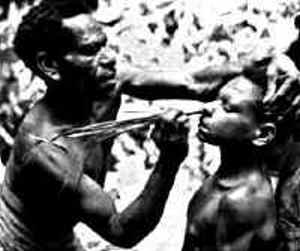
BUT, one lecture in particular could have been deeply distressing for some students, and I'm ashamed that I never thought of this until recently. For this week of work, we looked at sexuality, and our case study was Gilbert Herdt's work with the Sambia people of Papua New Guinea. Among the Sambia, the only way for a boy to become a man is for him to ingest semen, which he receives orally from older men. The young boys are also toughened up with beatings, and ritual nosebleedings (shown in the picture at the top). Our point (linked to Mary Weismantel's brilliant paper on Moche pots) was that you cannot define easily what is sexual, and what is abuse. From a Sambia perspective, one could argue that Western boys are abused as they can never fully become men. There is also an uncomfortable argument to engage with about abstract concepts of morality, and respecting indigenous practice vs feeling pity for the children involved. The lecture never failed to spark debate and get people questioning themselves, which was our hope.
AND YET. What if someone in the room had been sexually abused as a child? Beaten and forced to perform fellatio? How profoundly distressing and uncomfortable the experience of learning about the Sambia would be, what dreadful memories could have been dredged up, what damage could we have done as lecturers where we had hoped to inspire?
So, in short, we needed to let students know what was coming. We needed a trigger warning. With that session in mind, I think I'll always be more aware of this in my teaching. For the sake of a single sentence, it's better to avoid a lecture with potentially disastrous consequences.
