Confession: I'm frightened to even post this blog.
It's a week where I should be talking about a "Bones" topic. I was going to post the follow up to the NOT mysterious Etruscans piece. But I'm not doing that.
Instead, I want to talk about something sad, which is dressing up as feel-good fun (in some cases, literally). It's eating away at the subject I love, while simultanously pretending that nothing is wrong, and, in fact, things are better than ever. I am tempted to get all melodramatic and go the whole way with playing as the Titanic sinks metaphors, but I'll spare you the hyperbole.
If this issue is so important, why on earth haven't I mentioned it before? Well, the answer to that is because it's so personal, and so loaded. I didn't want to be accused of negativity, of not wanting to do hard work to get rewards, of being lazy, of being over-priveleged. I wrote a few weeks ago about failure, then dressed it up in pretty words of perseverence and positivity. There's not much to sugar coat this particular topic with, at least for me. The worst part is that I'm complicit in the system- I'm now a part of it.
That system is working for no pay, and looking happy while you do it. Also known as volunteering. Emily Johnson bravely raised the issue on Twitter today, and has blogged about it here. There's a whole discussion going on over at her blog and on Twitter (#FreeArchaeology), and it's given me the courage to post my two cents here.
So, what's not to love about volunteering? Passionate people get to help others, the state saves some cash, and heritage organisations get the help they need? The problem is that those passionate people need to live. They have rent to pay. They have food to buy. They might even (once in a while) want to buy a book to read up on the very areas in which they work. A large number of those passionate people are living with large debts from university qualifications which, while securing them a volunteer position, haven't got them anywhere near a job.
I appreciate that not everyone can work in the industry they want to (even after a long hard slog to get the qualifications they supposedly needed). I know that volunteering provides an opportunity to try new things, and to gain skills (I know this first hand as I'm doing it now). BUT A VOLUNTEER SHOULD NOT BE DOING THE WORK OF A PAID EMPLOYEE FOR NOTHING. I'm lucky with where I volunteer- they are supportive and only ask for one day a week during school holidays. I love the work and the people involved. But they won't be giving me a job at the end of it, even if they write a lovely reference. I know people who have interned or volunteered for extended periods of time- given their labour, for free, to organisations with no intention of employing them. They didn't get permanent positions either.
No matter how much you dress it up in shiny "Big Society, heritage for all" rhetoric, this is work without pay and without prospects. It's open only to those who can afford to take time out from working, supported by parents or partners. (I do mine in the small hours-per-week working quota permitted by my AHRC funding, which I am INCREDIBLY lucky to have).
Working for free isn't just a problem for archaeology (Guido Fawkes has been campaigning for unpaid internships in politics to be banned), or for recent graduates or early career professionals. I don't have a clue what the potential solution is, or what can be done to change the current situation. The problem is that I am too selfish to really battle for change. I am already doing work for free, I don't want to rock the boat. Any protest that limits my chances of eventual paid employment in heritage/archaeology/academe is one that I'm too cowardly to join.
Outside, the sheep in the field are being rounded up to go to slaughter. There's an over-the-top metaphor there but I don't have the heart (or the balls, maybe) to make it.
Please go and post on Emily's blog. Or here. Or Tweet #FreeArchaeology with your thoughts. Maybe things aren't as bad as all that.
PS- there WILL be a Not Mysterious Etruscans post this week. Probably tomorrow or Wednesday.
Monday, 25 March 2013

Tuesday, 19 March 2013
Place: Moving around the place
It is absolutely gorgeous outside today. Spring is here, even if there will be snow tomorrow. I stopped to chat with our neighbours who own the farm, and they were saying that last year the cows had been out for 2 weeks by this time! No sign of them yet this year- it's all sheep sheep sheep.

One of the best things about the spring is being able to enjoy wandering around the landscape looking at things. I did this a bit in autumn (and blogged about it) but it's right now, now that I've been here a few months, that I'm really starting to know where places are and how they connect up. Running has helped- experimental runs that end up following lanes and being a good 2km out of your comfort zone are great for landscape knowledge!
This got me thinking about building knowledge about the places where we live? How do we do this? How did people do it in the past?

Well, there's maps. Old ones and new ones. There's something really magical about the way maps work- putting down on a piece of paper not only where things are, but also what they look like and what they'll feel like for your body. You know when you see the contour lines scrunch up into an evil cluster that you will be gasping for air if you run up that hill (thanks Kate Bush). OS Maps are a pleasure, a treasure trove- hunting out the gothic writing that suggests there's something old and exciting right on that spot. But maps aren't just simple sheets of paper that you can whack in your pocket and use to find out where the nearest pub is. Maps are made by people- and people have ulterior motivations, passions and beliefs that structure how they draw out the land. OS Maps themselves are the product of the Ordnance Survey, a government sponsored project begun in the 18th century. The Ordnance Survey began as an act of colonial dominion in the aftermath of the Jacobite rebellion- a survey was made in 1747 to ensure that government forces would never be at a disadvantage in terms of knowledge of terrain. The entire country was eventually covered, and the official Ordnance Survey was founded in 1791: just in time for the Napoleonic wars. In the event of an invasion, these intricate maps would provide Britain's defenders with all the knowledge required to fight Boney's evil forces. And that's nothing compared to the politics behind medieval and early modern period maps, especially of the New World- literally carving out nations and ontologies on a piece of paper. Far more important to place Jerusalem at the centre of the world and claim all the unknown lands for Her Majesty Queen Elizabeth than to get a river in the right position.

Maps are perhaps the most formal way of noting what's where. Literally moving around maps the ground into your brain perhaps more effectively. You end up remembering where things are based on experience, rather than an abstract knowledge, although sometimes the two match up. For example, I know if I go to Shore Bottom, I will meet these two and their noisy friends:
 So it's really "the place where the loud collies live" in my head. Then there's the top of the hill- where you can see all the way across the valley.
 When I get back from my run or walk, I think through the places I've been. The markers I assign them are based on what I feel, what I experience, what I see. So, this is the place where the ford flooded really badly. That is the place where I went to sledge in the snow. All these things are linked to activities or happenings- that's the place where I tripped over into the ditch. The anthropologist Tim Ingold, quite some time ago now, developed the concept of taskscape- the landscape composed not of passive features, but of happenings, of doings (Ingold 1993). Incorporated into this is the idea of time- the taskscape transforming, the world around us changing, as we change the things we do in it. To that, I'd like to incorporate thinking as doing. Thinking though the world and our experiences of it create a series of task like impressions on our inner maps of where we go and what we do. Taskscape yes, but memoryscape more so. If you do the same thing in the same place, create the same memories and pass them on, the land around you becomes imbued with stories, happenings, doings and thoughts. Places become sites of storytelling, accumulating memories. While places in the past may have been caught and bound up and squodged into shape in maps, inside people's heads they were still composed of all the flotsam and jetsam of their lives. That's what makes place from space.
Reference- this is very easy to read and a real eye opener. I love it as much as I did the first time I read it in the first year of undergraduate study.
Ingold, T. 1993. The temporality of the landscape. World Archaeology 25: 152-174.
If you'd like to read more about the social context of maps, this volume is pretty good.
Klein, B. 2001. Maps and the writing of space in Early Modern England. London, Palgrave Macmillan.
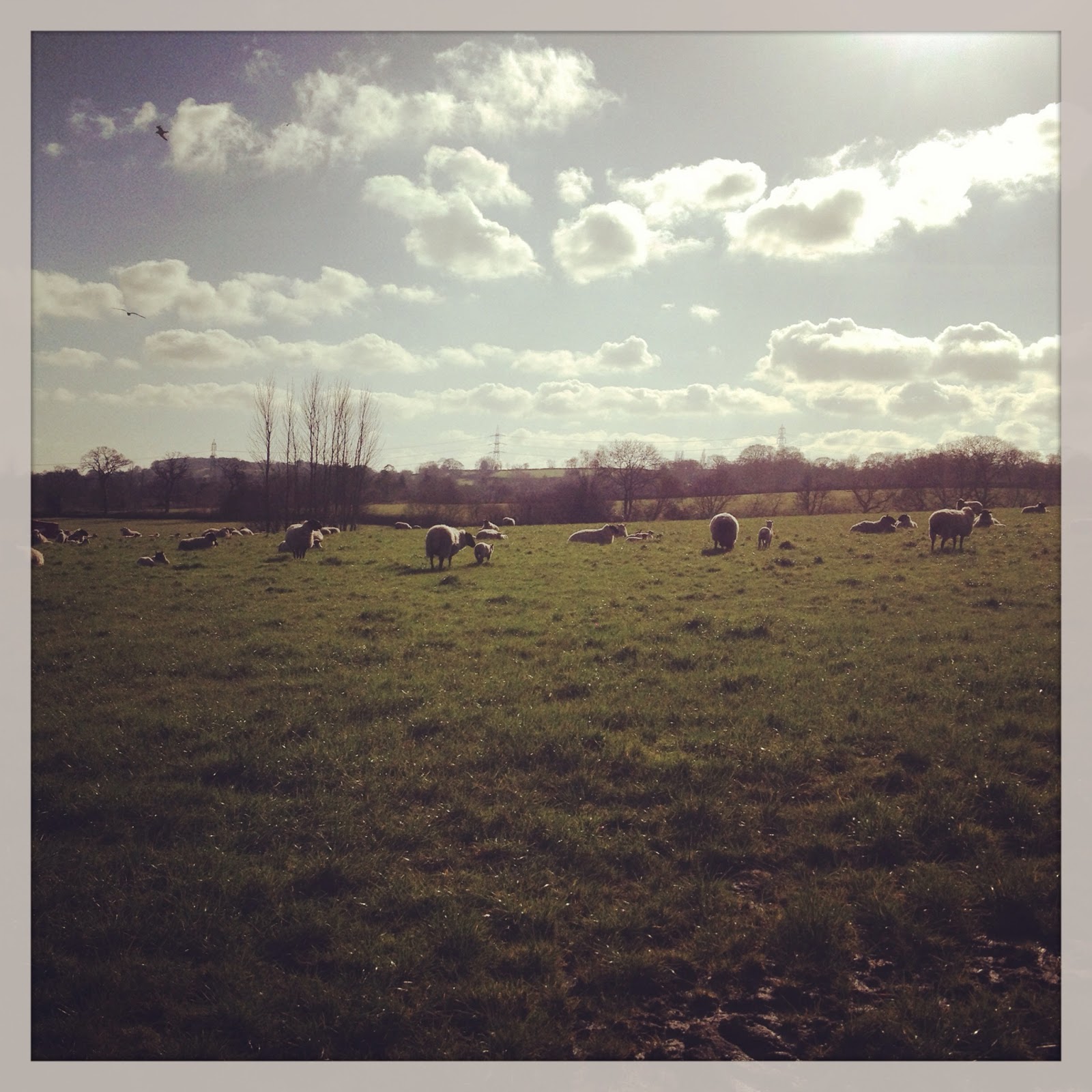
One of the best things about the spring is being able to enjoy wandering around the landscape looking at things. I did this a bit in autumn (and blogged about it) but it's right now, now that I've been here a few months, that I'm really starting to know where places are and how they connect up. Running has helped- experimental runs that end up following lanes and being a good 2km out of your comfort zone are great for landscape knowledge!
This got me thinking about building knowledge about the places where we live? How do we do this? How did people do it in the past?

Well, there's maps. Old ones and new ones. There's something really magical about the way maps work- putting down on a piece of paper not only where things are, but also what they look like and what they'll feel like for your body. You know when you see the contour lines scrunch up into an evil cluster that you will be gasping for air if you run up that hill (thanks Kate Bush). OS Maps are a pleasure, a treasure trove- hunting out the gothic writing that suggests there's something old and exciting right on that spot. But maps aren't just simple sheets of paper that you can whack in your pocket and use to find out where the nearest pub is. Maps are made by people- and people have ulterior motivations, passions and beliefs that structure how they draw out the land. OS Maps themselves are the product of the Ordnance Survey, a government sponsored project begun in the 18th century. The Ordnance Survey began as an act of colonial dominion in the aftermath of the Jacobite rebellion- a survey was made in 1747 to ensure that government forces would never be at a disadvantage in terms of knowledge of terrain. The entire country was eventually covered, and the official Ordnance Survey was founded in 1791: just in time for the Napoleonic wars. In the event of an invasion, these intricate maps would provide Britain's defenders with all the knowledge required to fight Boney's evil forces. And that's nothing compared to the politics behind medieval and early modern period maps, especially of the New World- literally carving out nations and ontologies on a piece of paper. Far more important to place Jerusalem at the centre of the world and claim all the unknown lands for Her Majesty Queen Elizabeth than to get a river in the right position.

Maps are perhaps the most formal way of noting what's where. Literally moving around maps the ground into your brain perhaps more effectively. You end up remembering where things are based on experience, rather than an abstract knowledge, although sometimes the two match up. For example, I know if I go to Shore Bottom, I will meet these two and their noisy friends:


 |
| This is where I got stuck in brambles and had to be rescued. It looks so innocent now, but at the time it was NOT funny... |
Reference- this is very easy to read and a real eye opener. I love it as much as I did the first time I read it in the first year of undergraduate study.
Ingold, T. 1993. The temporality of the landscape. World Archaeology 25: 152-174.
If you'd like to read more about the social context of maps, this volume is pretty good.
Klein, B. 2001. Maps and the writing of space in Early Modern England. London, Palgrave Macmillan.
Monday, 11 March 2013
Pots: On Telly- Stonehenge and the Etruscans
| Stonehenge- Image English Heritage. |
As you might have guessed from the Richard III post I wrote a few weeks ago, I do spend a fair bit of my off time watching archaeological TV. When archaeology hits the screen, I'm usually to be found gurning and growling or glued and gibbering in front of whatever programme is featuring what is officially my "work." The thing with research in a topic that you love is that it will seep into every second of your daily life- so that a documentary with seemingly very different archaeologial strands to your own specialism will suddenly strike a big fat chord. That phenomenon happened to me last night- Sunday post-roast doze interrupted by some fantastic archaeology on TV and then the sudden ZING of ideas into my brain.
Because, you see, the Etruscans are connected to Stonehenge. Honest. This isn't just a tagline to lure in the crazies that think that both were influenced by aliens or possessed a secret occult knowledge. All will be revealed, I promise, just bear with me...
So, "Secret of the Stonehenge Skeletons" aired last night on Channel 4, a channel making up for its recent production sins with a fantastic example of how TV archaeology should be done. It was presented by the genuinely lovely Mike Parker Pearson (he was a warm and gentle interviewer to me as an 18 year old so it's not just a screen persona). MPP is one of the leading experts (if not THE leading expert) on Stonehenge- he's used all sorts of innovative ways to transform the way we think about the monument and other Neolithic megalith sites- my favourite is his work collaborating with Malagasy archaeologist R. Ramilisonina to consider associations between ancestor worship, stone and wood (published in Antiquity, which means you can't read it without a library subscription sadly- it's here anyway. You can get the scoop on the latest results of MPP's work in his new book, here). The programme used some of the latest scientific tests on burials from Stonehenge and faunal remains from the neighbouring site of Durrington Walls (and EXPLAINED the methods properly showing the charts- hurrah!*) to argue that Stonehenge served as a communal place of celebration and festivity for groups coming from as far away as Orkney to venerate a group of elite ancestors buried there in the earliest phases of the monument. So far, no Etruscans.
 |
| The Amesbury Archer- Image Salisbury Museum |
Having put forward this interpretation, MPP turned to change. Why did Stonehenge stop being important? Why was Durrington Walls abandoned around 2500 BCE? He suggested that in addition to new individuals coming into Britain from Europe, new ideas about identity came too. People stopped caring about communal ancestors- they wanted recognition for their individual, living selves. MPP suggested that the introduction of inhumation (burial of the entire corpse, as happened to the Amesbury Archer, above) with grave goods indicated an increased concern with recognising the individual in death, which co-incided neatly with the importation of new material culture from Europe- particularly "Beaker" pots and metal daggers.This emphasis on the self, rather than the whole, lead to the construction of smaller barrows, celebrating the recently dead, rather than to huge megaliths as monuments to groups of shared ancestors. Quite a few people (especially vocal last night on Twitter) weren't fans of this interpretation of social change in the Neolithic/Early Bronze Age. They suggested that it's a narrative born from modern events- particularly the negative reaction to Thatcherian selfishness. Essentially, greed is good supposedly destroyed the happy hedonism of the 70s... just like imported egos resulted in the decline in monument building.
 |
| Biconical urn- Image Musei Vaticani. |
 |
| Canopic urn on throne. Image: Trustees of the British Museum |
So, thinking things through, what we have is a practice of reconstructing the dead body into a shared, universal form. In spite of the high level of resources needed to produce a pyre, the result is the removal of all individual identity from the deceased- they become fragments of bone, rather than a whole, dressed corpse. The re-dressing and re-building of these parts into a new body does not recreate the specificity of that individual's living body: it puts them together in an urn marked with decorations declaring communal identity. The dead person is not represented as a single unique person, but rather as the amalgam of their geographical and familial connections. What happened to change this? I think increased trade did. Central Italy has huge iron deposits, providing a bank of wealth with which to trade and acquire other prestigious objects once the resource began to be exploited. The explosion of trade that we can see in the Seconda Eta del Ferro gave Etruscan elites the opportunity to convert their wealth into material objects, but it also did something else. It placed the responsibility for wealth creation squarely on the present generation- on the individual, not on the ancestors. The sharing of identity in death, the melding of individuals into identical urn bodies full of burned bone, was no longer relevant for people whose self-identity was tied up in their own wealth creation and possessions. This change didn't happen overnight- it started with the dressing and personalisation of urns and the addition of a few pots, weapons and ornaments, before becoming individual burial mounds filled with objects. Tumuli and these so-called princely burials full of imported goods eventually developed into the elaborate and highly personal tombs of the Archaic period. Even where cremation continues, like at Chiusi, urns become more and more the seat of the individual- expressions of self, rather than of community.As wealth spreads to more individuals, single tumuli become multiple tombs.
 |
| MUCH later cremation urn from Chiusi. Image: wikimedia commons/Metropolitan Museum New York |
What do you think? Did you watch it?
*The programme wasn't perfect though- it drives me CRAZY when people refer to the Neolithic as the Stone Age. I know it's technically correct, but public perception of the Stone Age is of the Paleolithic- you hear Stone Age, you think "caveman." Nobody thinks of the Neolithic, and less than nobody thinks of the awkward middle child of prehistory, the Mesolithic, unless it's to talk about Star Carr and leaping around with antlers on your head (slightly unfair). Even if this gap between perception and archaeology didn't exist, the "Stone Age" is a bloody long time to slop together into one term (Sorry Thomsen, sorry 3 age system). Let's have less lazy terminology and more clarity please. Nitpicky mean rant over.
** I think the phrase, in addition to having some very unpleasant colonial baggage (see Edward Said's "Orientalism"), places the Etruscans as passive receptors of exotic Eastern wonders. Yes, new types of material culture inspired by contact with the Eastern Mediterranean were arriving in Etruria- but how were they getting there? Who was choosing to incorporate them? Why? I like "Seconda Eta del Ferro" as it neatly dullifies the period (is dullify even a word?). You can't attach origins hypotheses or post-colonial critique to something as boringly, safely prosaic as Seconda Eta del Ferro- it just won't let you.
References
DeAngelis, D. 2001. La ceramica decorata di stile “villanoviano”
in Etruria meridionale. Soveria Mannelli: Rubbettino.
Said, E. 1978. Orientalism. London: Penguin.
Said, E. 1978. Orientalism. London: Penguin.
Tuck,
A. 2012. The Performance of Death. Monumentality, burial practice and
community identity in central Italy's urbanizing period. In M.
Thomas, I. Edlund-Berry, and
G. Meyers (eds.) Monumentality in Etruscan and Early Roman
Architecture: Ideology and Innovation. Austin: University of
Texas Press, 41-60.
Tuesday, 5 March 2013
Stone: Failure Festival
Last week I read a fantastic post by the brilliant Matt Law, on his blog. You can read it here if you'd like- and I recommend that you do! He wrote about what he called a carnival of failure- people being honest about things that have gone wrong for them in digital scholarship and public engagement. Matt talks about failure as a positive, learning experience and then bravely goes on to analyse a sticky patch in his own work. A wonderful friend and teacher, Sara Perry, has also been incredibly brave in talking on her blog about the ups and downs of her first year in academe- a real inspiration of honesty.
Matt points out that, as academics, we don't often talk about failure. I think you could extend that to most jobs. Our professional personae do not have room for messing up, for things going wrong, for the days when you just want to hide under the bed curled in a ball crying. My twitter feed and this blog are always relentlessly positive: even when I'm grumpy, they are (or try to be) constructive and analytical rather than down and sad and whinging. You just can't fail publicly and get away with it, it seems. Failing is one thing, but fail behind closed doors- perhaps this is why people are negative on Facebook, where only "friends" will see us.
But what is failure? What does it mean to you? Failure for me is a thousand different things. At the moment, I'm about to finish writing up the first draft of my PhD thesis (last but one chapter in process). My AHRC funding runs out in September. Then I'm on my own. Every day is dogged by fear of a different type of failure: that my supervisor will hate my work (I know she doesn't and would NEVER make me feel like that), that my viva will be a disaster (I had a nightmare that I had to walk into my own viva party and tell them I'd been recommended for an MPhil). Those are just the thesis related failures! I'm scared I will never get anything from the thesis past peer review, and fail to get my research out there. I'm scared stiff of what will happen to me in September- or what I make happen to me. All those academic job apps that I posted about so chirpily a few months ago? Great learning experience, but they were rejections, every one of them. What if I have to leave the academy? Is that failure? What if I can't get a job in archaeology at all? Will I have failed in a dream I had since the age of 3? What if I can't transfer my skills to the non-academic workplace? What if I have no skills? What if I can't get any job, any job at all?
Those are just the job failure fears. And they are ugly. They do not make for good CV material. They do not make for good Lucy PR. But they are real, and they are honest. I suppose they tell you that at least I care about these things. Or do I? Looking at that list of potential failures with a hard eye, they are ridiculous. Why? I'm sure each of those things would make me sad, and very downtrodden for a while. But they would pass. I have failed before, although not on such a grand scale. I would cry, I would hide, I would probably cancel this blog for a while and put my face away from the world. But, in the end, as long as I get to be happy again, I won't have failed. There is never only one path to happiness and to success. The negativity of failure cannot win unless we let it.
I bloody hope that all the silly failures above don't happen, but what are they compared with, say, losing someone you love? Making the right decisions for a terminally ill child? Battling cancer? At the end of the day, those are all things that are too sad and too deep for the word failure to be anywhere near them. Failure can be turned to success, or at least to a new chance and a learning experience. Painful, gut wrenchingly awful circumstances cannot be anything but lived through. Yes, lets be open and honest about our petty day to day failures, our fears and troubles. Let's celebrate them, share them, laugh at them. It takes the fear away. Most of all, I will try to remember that these little failures will pass and that I am fortunate to be able to fuss about them at all. Compared to the real tragedies of life, they are nothing.
Matt points out that, as academics, we don't often talk about failure. I think you could extend that to most jobs. Our professional personae do not have room for messing up, for things going wrong, for the days when you just want to hide under the bed curled in a ball crying. My twitter feed and this blog are always relentlessly positive: even when I'm grumpy, they are (or try to be) constructive and analytical rather than down and sad and whinging. You just can't fail publicly and get away with it, it seems. Failing is one thing, but fail behind closed doors- perhaps this is why people are negative on Facebook, where only "friends" will see us.
 |
| Stormy weather |
Those are just the job failure fears. And they are ugly. They do not make for good CV material. They do not make for good Lucy PR. But they are real, and they are honest. I suppose they tell you that at least I care about these things. Or do I? Looking at that list of potential failures with a hard eye, they are ridiculous. Why? I'm sure each of those things would make me sad, and very downtrodden for a while. But they would pass. I have failed before, although not on such a grand scale. I would cry, I would hide, I would probably cancel this blog for a while and put my face away from the world. But, in the end, as long as I get to be happy again, I won't have failed. There is never only one path to happiness and to success. The negativity of failure cannot win unless we let it.
 |
| How can I be afraid to fail? There are lambs in the world, for goodness sake. |
I bloody hope that all the silly failures above don't happen, but what are they compared with, say, losing someone you love? Making the right decisions for a terminally ill child? Battling cancer? At the end of the day, those are all things that are too sad and too deep for the word failure to be anywhere near them. Failure can be turned to success, or at least to a new chance and a learning experience. Painful, gut wrenchingly awful circumstances cannot be anything but lived through. Yes, lets be open and honest about our petty day to day failures, our fears and troubles. Let's celebrate them, share them, laugh at them. It takes the fear away. Most of all, I will try to remember that these little failures will pass and that I am fortunate to be able to fuss about them at all. Compared to the real tragedies of life, they are nothing.
 |
| Everything's going to be alright? |
Tuesday, 26 February 2013
Bone: NOT mysterious Etruscans (vol.1)
 In my first bone post I wrote a pretty safe introduction to the Etruscans, their world and the wonderful things they made. I alluded to a couple of inconsistencies in the way the Etruscans are presented in the modern world, and promised to address these later in another blog post. I've actually decided to go ahead and make this into a series for the blog- there are just so many to deal with!! The title for this post is inspired by perhaps the biggest Etruscan website on the internet- mysteriousetruscans.com Now, I have no problem at all with popular Etruscology. The website is actually pretty good! It has a tonne of pictures, some lovely guides to different tomb paintings at Tarquinia, and is a fun introduction to the Etruscans. But there are two things I find difficult, both on that website in particular, and in the majority of presentations of the Etruscans. I'm going to address the first one in this post, and the second in the next "Bone" post.
The first one? Clue's in the name. Mysterious Etruscans. It's a hook, a meme, a trope. It ends up with (I swear I'm not making this up) people alluding on Twitter to the Italian election results as being as mysterious and impenetrable as the Etruscans!!! It influences reconstructions of Etruscan life, like this rather sultry and spooky image above*. It also results in crazy, hysterical films such as The Etruscan Kills Again (L'Etrusco uccide ancora).
Why has this stereotype evolved? Well, as far as I can gather, there are four key features which make the Etruscans so supposedly "mysterious."
The first of them is the fact that the Etruscans are commonly thought to have just plain old disappeared. Roman action during the conquest of Etruria is conceived of as a cultural and physical genocide, with Etruscan culture dying out forever, leaving a tempting glut of so-called "lost" knowledge. It seems, however, that the Etruscans were actually absorbed into Roman culture, rather than wiped out. One of the most famous Etruscan artefacts, the Piacenza liver, used for the quintessentially Etruscan activity of fortune-telling, dates from the second century BC- long after the Roman conquest. It was (according to legend) an Etruscan haruspex or fortune teller who told Julius Caesar not to go to the Senate on the fateful Ides of March. Togas, gladiators, lituus staffs- all Roman objects with an Etruscan origin. However, it is in the Roman adoption of Etruscan objects, and interest in Etruscan culture, that I think the presentation of the Etruscans as mysterious begins- the Emperor Claudius commissioned a study of Etruscan religious belief, suggesting that by the first century AD, after a long period of assimilation, Etruscan and Roman identity had become one and the same, prompting interest in the recovery of the former. So, treating the Etruscans as mysterious has a long heritage!
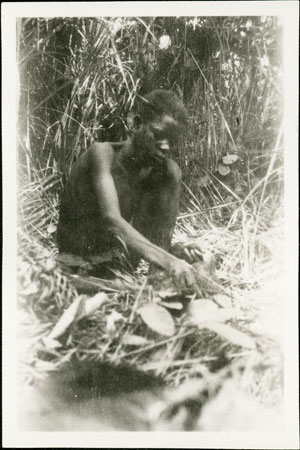 |
| Azande oracle |
This Otherness is the third reason for the presentation of the Etruscans as mysterious. Developed out of the work of Hegel, Husserl, Lacan and Levinas, the Other is the opposite to the Self, or the Same. Etruria was always the Other- to Rome, and, prior to that, to Greece. The Etruscans were a source of disgust and fascination to both cultures- the two central sources which informed the Renaissance, and shaped our modern Western world. As heirs to the classical legacy, we have also inherited the biases of Greece and Rome: the Etruscans are firmly Other to their Same. Women dine with men, animals are not sacrificed but cut open to view the entrails, children do not know who their parents are- Etruria is presented as a topsy-turvy land of contradiction by both Greeks and Romans. The same sense of mystery and fascination visible in classical texts which speak of the Etruscans is continued both in popular and academic literature. The response to this is often a fascination with a people who appear far "freer" than their uptight, influential, contemporaries:this seems to be a central feature of interest in the Etruscans, an interpretation particularly visible in the work of D.H. Lawrence (on whom more another day).
.jpg/400px-Lanena_knjiga_(Liber_linteus_Zagrebiensis).jpg) |
| Liber Linteus texts, image wikimedia commons. |
The fourth and final reason that we think of the Etruscans as mysterious concerns the same classical texts that tell us how the Greeks and Romans felt about their neighbours. The Etruscans themselves were literate- yet almost their entire literary canon is lost forever. No Etruscan Hesiod, Homer, Plato or Euripides. No Cicero, no Ovid, no Virgil. By writing almost exclusively on linen books, Etruscan authors were almost certain to be burnt, reused or lost over time. The most extensive Etruscan language work in existence is the Liber Linteus- a selection of extracts from a linen book, used to wrap an Egyptian mummy now in Zagreb. There are inscriptions and brief dedications, but the lack of extended literature leaves the Etruscans without a voice in the modern world. Their language, a non-Indo European variant, has still not yet been fully translated, leaving the Liber Linteus only partially understood**. We are left with the fetishised vision of the Greek and Roman Other, and the material culture of the Etruscans themselves- and the former has built up its influence on popular perception over the centuries. Etruscan archaeology can, will and does demonstrate that the Etruscans were so much more than mysterious- but its first task is to overcome the classical biases which have become so deeply engrained in our modern cultural psyche.
* The figure of the woman "lifts a light" on the mysterious beings inside, while the figures are all focused on the viewer rather than their activities or companions. The whole image has the sense of a secret, exclusive party which the viewer is crashing!
** See L.B. van der Meer's Liber linteus zagrabiensis. The Linen Book of Zagreb. A Comment on the Longest Etruscan Text, published in 2007, for more on this.
Wednesday, 20 February 2013
Place: The Land of Ad Hominem
 |
| St James's Palace. Image: British Monarchy Society |
This post isn't about pretty snaps of places I've been or where I live. Place posts should be about more than that. This post is about the world we live in. Not all of it, that would be impossible, and pretentious. It's about one aspect of modern society- more specifically, one aspect of the way modern society likes to argue and to comment. I suppose it is an inevitable place in which we've ended up, but I definitiely do not like it. This post has been brewing for a while, but a media/Twitter tsunami yesterday had me at the point of raging. Hopefully I've calmed down enough not to rant.
 |
| Hilary Mantel. Photo (c) The Week |
So, yesterday, if you didn't already know, some remarks made by Hilary Mantel, one of the most important writers yet living, given at a lecture six days ago, were published. They commented on the hypocrisy of the press, the public interest in the monarchy and bravely considered the author's own reaction to meeting the Queen. They also made historical connections between current Royals and their (sortof) ancestors. So far, so good. What stirred up the press to outraged self-defence masked as defence-of-the-realm was a few comments on the public perception of the Duchess of Cambridge. It was very clear that these remarks were based on the way Kate is perceived, and were not comments on her personality or personal life: just her public persona. They were a central part of an argument about the continuing interest in and role of the monarchy. The attack was firmly on those who whip up that interest into obsession, with tragic consequences in very recent memory. The predators of the press did not like this exposure. Not at all. So they turned upon the author who gave the lecture, presenting her remarks as a vicious personal attack, reducing a well balanced lecture to a cat fight, and finally dragging in the author's weight and own childlessness as proof of her jealousy and vindictive nature. The Daily Mail were the first (and worst) offenders. They were quickly followed by other sections of the press, who began reporting on the media storm itself, repeating the same details over and over. Other groups, particularly on Twitter, rose to the author's defence. The PM got involved. It all got very silly, very quickly.
Some people, including the author of the Guardian's lead on the story, consider the ensuing fuss to be the result of paternal media trying to diminish a strong female voice to heap praise a conformist obedient role model. I think that they've missed the point: a man would not have got away with such a strong attack on the press either, and the gender argument would be being used against him. Male or female, the problem is that it has not been, and would not be, the words and argument under scrutiny. Instead, it is the speaker themselves. Their views, their points, their logic are all useless in the face of personal facts. Mantel is childless and overweight. In another context, David Cameron is out of touch and upper class. Ed Miliband is a champagne socialist. In yet another, more horrible context, the attacks on Mary Beard a few weeks ago were shameless examples of this, as are almost all works of internet trolls. The same phenomenon lies behind comments on the horrific events surrounding the death of Reeva Steenkamp: her beauty and the combination of disability and fame in the person who killed her have become central to reporting of the case, even though they are irrelevant to the arguments about what happened that night. It has become the person, and not the argument, which is under scrutiny. You hear this every day- try getting through half an hour of the Today programme without hearing this tactic employed. You will see it in the newspapers, see it on the TV, see it everywhere that debate takes place. It has filtered down to become everyday usage. And this is shocking.
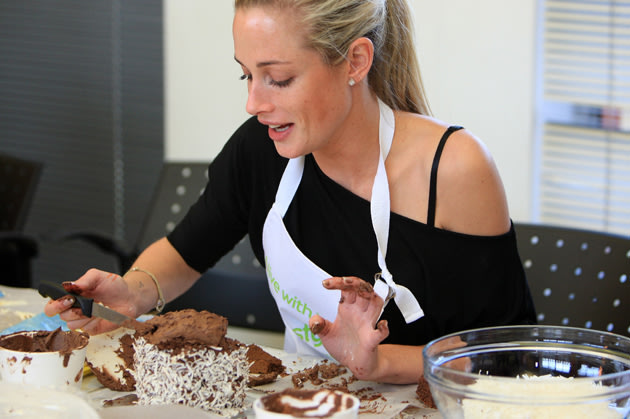 |
| Reeva Steenkamp. Image: Yahoo. |
It is shocking because the use of a person's opinions, social position and identity against the logic of an argument is one of the most classic fallacies identified by critical thinking. It's known as "ad hominem"- taking a debate "to the man." The point is that it doesn't matter who the speaker is or what they believe- the cold hard logic of their case is what counts towards the strength or weakness of their argument. In the rush of post-structural desires to recognise biases, to be aware of our own subjectivity, to recognise the potential for prejudice, we have forgotten the centrality of logic to argument, the need to be critical, impersonal. Many of the people who were so offended by the attack on Mantel are those who have contributed most to the creation of this atmosphere of hyper-subjectivity. We have collectively made a world in which ad hominem attack is the norm. Now we have to live with it.
Tuesday, 12 February 2013
Pots: Actual Bleddy Pots!
Well, last week was pretty exciting on this 'ere blog. Due to a bit of shameless self-promotion, some of the great and good of the Twitterati kindly tweeted links to the blog and some lovely feedback too. If you are reading this this week, thank you so much! I tried to thank everyone individually on Twitter, but if I failed, or if you looked at this blog to check out my Richard III piece and are back for more, then THANK YOU VERY MUCH! This post was always going to struggle to be as exciting as last week, however...
Fun as dissecting TV archaeology is, it isn't actually what I do day to day. I did say when I started this blog that "Pots" type posts were meant to be about daily life. So, I thought I'd write about what more or less is the crux of my daily existence- my research on Etruscan pottery. Please don't stop reading. Pottery has a bad, bad reputation that it doesn't deserve. OK, grotty nasty British pottery does. Sometimes. And finding endless sherds of poorly made eroded yuk when digging isn't exactly an advert for the glamour of ceramics. Five years ago, I too would have turned off at the mere mention of a pot. Back then, they were for people who liked petrographic analysis (cutting pots into slivers to examine their chemical composition....not my thing). But it turns out that pots are a lot like men (or women, whichever you want to use in this metaphor). You can swear off them all you like, but it will turn out that there'll be one that's just right for you. For me, it was Etruscan bucchero pottery. You can see me grinning in the picture like a loon in the Athens Archaeological Museum next to their sole case of bucchero- never mind the marble sculptures, I want black shiny Italian pots. This is on my honeymoon as well, just so you know how crazy I am about these pots. There are some other very nice Etruscan things in the case too- a Villanovan hut urn and Chiusine canopic urn, both for cremation burials. But back to the bucchero: the black colour is produced by a careful process of firing- heating the pots so that they set. By controlling the amount of oxygen, and burnishing the clay, you could recreate the shiny, luscious effect of bronze in (much cheaper) clay.

I don't really want to talk too much about bucchero, although it's great. I want to talk about pots themselves- what do we do with them? And what are they for? These are two really basic questions that drive my research on some particularly elaborately decorated Etruscan pottery. One of the things I'm really interested in is how pots themselves shape and twist your body into certain positions in order to use them. Usually, it's your hand, arm and mouth that get involved, with fingers put in all sorts of places. The pots, the inanimate objects, have the agency and power to enforce your usage of them in a particular way. Well, to strongly encourage you to use them in a specific way- the endorsement of that method by your social group does the rest. To illustrate this, I gathered together a gang of modern day pots (including glasses) and had a play around with what they made my body do.


The first two were quite easy. They were both made of glass- a small water glass and a pint glass. You'll have to excuse my continued vapid expression in all these pictures. The small glass only required me to wrap a single hand around it, and no thought at all to control the flow of liquid. The larger glass was heavier and more difficult to use, but still easily controllable with one hand. I'd imagine that a large pint glass would be very tough for a child to use- requiring the use of both hands and a technique to control the outflow of liquid into the mouth.


The next two pots were a bit more demanding, although still both made of glass. The first one was a tankard with a strongly formed handle. You couldn't really pick it up without coming up against the handle in some way. The most natural way of using the vessel felt like putting all my fingers into the handle space and wrapping my thumb around around the body of the vessel. Lifting the glass like this required my whole arm to move in an almost straight line, rather than just bend at the lower arm- a completely different motion from the first two glasses. It's interesting- I don't like using these glasses, but my husband loves them and will choose them ahead of any other type of container in the cupboard. The second glass I tried is a bit of a funny one- it's meant to be a wine glass, but is wider and has a low foot. It demands (from me anyway) a twist in the hand. My ring finger and little finger are focused on the stem and base, while the two fore fingers and thumb wrap around the bowl. It looks convoluted in the picture, and I suppose I could just pick it up by wrapping my fingers all the way around the bowl- but that just doesn't feel secure, it doesn't feel right. Whether that comes from the pot or from me, I don't know.


The final pair of pots were actually made of clay- two different types of mug, which are really the only type of drinking vessel that's made of clay that I could find in the house. The first one is a posh wedding present mug- it keeps the large volume of a vessel designed to deliver lots of liquid, but tries to show off with a handle which is actually pretty demanding. The handle is just too small for me to put all my fingers through- and I don't have big hands. My little finger is forced out, poking into the air or clinging to the body of the mug. When the mug is full, I can't really lift the mug with one hand comfortably- there's pressure on my index finger, which, particularly when the contents are hot, is not very pleasant. The second mug is my favourite of all the vessels I tried- it's huge, fits loads of liquid, and has a handle which is much larger and more comfortable to use. However- the handle is still a little small for my hands, and it is still easier to use two hands and cup the vessel.
The pots that I played with were all pretty relaxed in their demands on my hands, although a couple certainly pointed to particular ways of holding. If you compare these to a Victorian teacup, or an Attic Black Figure Kylix, a style of drinking vessel used in Etruria, you can see just how lazy my pots are.
 | ||
| Image from bettyannharris.blogspot.com |
 |
| Image via wikimedia commons |
This process of playing around with pots has been fun- but it's serious too! Objects structure our lives in all sorts of different ways- this computer controls how I use it, my chair controls how I sit on it! I'd love to know what you think about objects as active agents in modern and past lives.
Disclaimer: this approach is entirely phenomenological- based on experience and perception. I'm going to post in more detail about this style of approach in the future- it certainly isn't perfect.
Subscribe to:
Posts (Atom)