Somebody fetch me some new retinas (retinae?)
I thought I was a pro at proof reading. Smug statement, but based on fact. I proof read at work a LOT, and try and snag and snip and be as pedantic and annoying as possible to spot every last little typo or weird caption or funky line break.
But this week, I have proof read so far:
- a chunk of things for work
- two articles
- the entire text of my first book
The first two were ok. The work bits and bobs are concise and printed out and easy- you can't miss a page break in the wrong place when a caption is smeared across two pages instead of one. Even I can't miss that, and merrily curse myself and fix it.
The articles were also fine- a little harder to spot things amiss, on a screen and all. They were still neat, contained, and I could go through methodically line by line and section by section- the journal editors of one had organised the article in that way, and the other... well, I printed it off, just to be safe.
The book. That was a different kettle of leaping, jumping, flapping fish- too big to print, tricky to compartmentalise, so familiar that I finish its sentences for myself and have to FORCE my attention on every word, every letter. It's done- and it's fine, and I did find things wrong (always reassuring- if I don't spot a mistake, I assume I've missed one- that way lies paranoid madness).
But is there anyone smarter than me at this? (I really hope so, as I am pretty damn dumb). How do you fight your own lax mind, when it's striving to ignore what you can see and insert what should be there?
Let me know if there's a genius tip- hypno-proofing (can you tell I've been reading about hypno-birthing?), proof yoga, a 1000-words an hour proofing rule? Initiate me, o proofing priests and priestesses!
By the way, humble brag alert. The book (the first book) will be out soon. I'll no doubt post some gushy mushy yuck on here when it is, emoting about how the cover makes me feel. And all of you will leap from your computer screens weeping tears of joy at the chance to read about Etruscan pottery from a phenomenological perspective**. Yeah, you will.
** In an aside, Melvyn Bragg and company on In Our Time talked about phenomenology today. I think anyone studying philosophy or archaeological theory should have a listen- NOT to learn, but to feel comforted that Melv can't pronounce phenomenonmenonololology either.
Showing posts with label Habits. Show all posts
Showing posts with label Habits. Show all posts
Thursday, 22 January 2015

Monday, 15 April 2013
Pots: Booze Britain
Once upon a time, in a land before I got PhD funding, I worked in a nightclub. It was one of the most formative periods in my life. I made amazing friends, enough money to go travelling, and gained a lot of self confidence from the job I did. Writing up the second draft of my doctoral thesis, and looking at its conclusions, I can't help wondering if they would be the same if I hadn't worked in a club that will remain nameless for four happy, yet occasionally chaotic years.
I worked on the door during that time. I don't mean I sat behind a screen and took the money, either. It drives me nuts when people assume that's all I did- how sexist can you get? While I sometimes worked the till, I was part of a team that dealt with the dark side of student pissups. I cleared up vomit, pulled up knickers, rounded up so-called friends that abandoned drunks, broke up fights (usually by a combination of flirtation and headmistress voice but occasionally physically), administered basic first aid, yelled at queue-jumpers and generally tried to make sure people had fun, got drunk and didn't hurt themselves. I do sometimes wonder if the City and Guilds Door Supervision Level II was the most valuable qualification I ever got my grubby mitts on (and not just because I can use it to bridge that gap between PhD and gainful employment).
You know that my PhD is about pots, right? I posted a few weeks ago about the way that different pots control how you drink. Well, why do you need to control how people drink? Without those four years on the door, I don't know if I'd have made the link between ceramic controls, and social behaviour. Modern drinking vessels (pint and shot glasses, half-pint tumblers, alcopop/beer bottles) are ALL made for fast consumption- you drink quickly, you buy more booze, you get drunker. By using a cheat-technique (Jagerbombing, necking pints, strawpedoing) you can get even more down your neck in a shorter time. What is the effect of this? Here are the three major effects spotted from my time on the door as illustration:
1) Arousal. The amount of people eating face on the dancefloor will not come as a surprise. The amount of people taking things further, either in toilets or actually there against a wall or sat on a picnic table probably will. A loud "ahem" and an evil will result in this latter behaviour stopping, for the most part. Or loudly pointing out that the CCTV will make for amusing viewing in the morning. I'd love to know the amount of people who met their partner while drunk. I know I did. Anyway, the point is- this arousal can be a great thing- if you meet someone who returns your interest, and you both are free to have a good time. Or it can be amazingly destructive- unrequited attentions can quickly turn very nasty, leading to....
2) Aggression. The worst incarnation of this I ever saw was a man slashing another man's throat with a broken glass bottle. It was not nice. Not nice at all. Another incident resulted in me with two black eyes and a nose streaming with blood after catching an elbow in the face. Most "fights" involve a bit of pushing and shoving, maybe a thrown punch, lots of posturing and chest puffing out. The key is to get in there while the pre-violence rituals are going on, to stop the situation before it starts. Occasionally, there are incidents where unprovoked violence suddenly leaps up and punches someone in the face. It's not just men, either. Out and out cat fights were (mercifully) rare, but a lot of girls seem to enjoy barging into people, then telling their male friends they were pushed and gleefully watching the consequences. Or starting fights between rival suitors. The majority of incidents remained small scale, but were always uncomfortable. Most had the potential to escalate quickly, too. Full on fighting in the street between groups was utterly, utterly horrible, and luckily rare. But this consequence of alcohol is a pretty serious one. (The bloke who got his throat cut is alive and well, with a nasty scar. But it could have been very different).
3) Loss of bodily control. While linked to the two previous effects, I'm not talking about wobbling around or not being able to recite the alphabet backwards here, or about snogging someone you'd never normally fancy or getting mouthy. I'm talking about the girl who passed out in her own vomit on glass, resulting in cuts all over her back and hands, into which her own vomit had seeped. The bloke who was crying as he had no idea who we were and was convinced we were trying to hurt him as we fed him water and tried to find out where he lived so we could get him home. The many who pissed themselves. The even more who puked- sometimes on other people, often on me and my colleagues.
These were the effects of pots without any built in controls. The people who were using the pots I study had very different concerns. Can you imagine the extreme examples described above at a formal banquet in someone's home, in front of family and friends? Or at a large, public social event? Maybe social controls and environment would prevent the worst excesses, but seeing people pissed at wedding receptions and house parties makes me suspect not. But, just in case, pots so difficult to drink from that you couldn't just neck your pint and crack on to the next one were, I think, being employed. Look at the shape of this kylix. You need to be able to balance the bowl, negotiate the unwieldy stem, control the flow of liquid over the large rim, and deal with those handles. In my PhD research, I developed a scoring system for vessels like this, using handle shape, rim circumference/height ratio, rim circumference/human hand length ratio and volume. Vessels with a high volume (I'm talking an average of around 3l, which is about two modern wine bottles worth of booze), ususally imported from Greece to Etruria, always had high "skill scores." They needed knowledge to drink from them successfully, and they wouldn't allow you to consume their contents too quickly.
I don't know if I'd have noticed that, or even thought about it, without those years cleaning up puke and broken glass. So, thank you, pissed students. Except you, girl who threw up spaghetti puttanesca with tuna chunks in my hair.
 |
| Check the ear piece on that! |
You know that my PhD is about pots, right? I posted a few weeks ago about the way that different pots control how you drink. Well, why do you need to control how people drink? Without those four years on the door, I don't know if I'd have made the link between ceramic controls, and social behaviour. Modern drinking vessels (pint and shot glasses, half-pint tumblers, alcopop/beer bottles) are ALL made for fast consumption- you drink quickly, you buy more booze, you get drunker. By using a cheat-technique (Jagerbombing, necking pints, strawpedoing) you can get even more down your neck in a shorter time. What is the effect of this? Here are the three major effects spotted from my time on the door as illustration:
1) Arousal. The amount of people eating face on the dancefloor will not come as a surprise. The amount of people taking things further, either in toilets or actually there against a wall or sat on a picnic table probably will. A loud "ahem" and an evil will result in this latter behaviour stopping, for the most part. Or loudly pointing out that the CCTV will make for amusing viewing in the morning. I'd love to know the amount of people who met their partner while drunk. I know I did. Anyway, the point is- this arousal can be a great thing- if you meet someone who returns your interest, and you both are free to have a good time. Or it can be amazingly destructive- unrequited attentions can quickly turn very nasty, leading to....
2) Aggression. The worst incarnation of this I ever saw was a man slashing another man's throat with a broken glass bottle. It was not nice. Not nice at all. Another incident resulted in me with two black eyes and a nose streaming with blood after catching an elbow in the face. Most "fights" involve a bit of pushing and shoving, maybe a thrown punch, lots of posturing and chest puffing out. The key is to get in there while the pre-violence rituals are going on, to stop the situation before it starts. Occasionally, there are incidents where unprovoked violence suddenly leaps up and punches someone in the face. It's not just men, either. Out and out cat fights were (mercifully) rare, but a lot of girls seem to enjoy barging into people, then telling their male friends they were pushed and gleefully watching the consequences. Or starting fights between rival suitors. The majority of incidents remained small scale, but were always uncomfortable. Most had the potential to escalate quickly, too. Full on fighting in the street between groups was utterly, utterly horrible, and luckily rare. But this consequence of alcohol is a pretty serious one. (The bloke who got his throat cut is alive and well, with a nasty scar. But it could have been very different).
3) Loss of bodily control. While linked to the two previous effects, I'm not talking about wobbling around or not being able to recite the alphabet backwards here, or about snogging someone you'd never normally fancy or getting mouthy. I'm talking about the girl who passed out in her own vomit on glass, resulting in cuts all over her back and hands, into which her own vomit had seeped. The bloke who was crying as he had no idea who we were and was convinced we were trying to hurt him as we fed him water and tried to find out where he lived so we could get him home. The many who pissed themselves. The even more who puked- sometimes on other people, often on me and my colleagues.
These were the effects of pots without any built in controls. The people who were using the pots I study had very different concerns. Can you imagine the extreme examples described above at a formal banquet in someone's home, in front of family and friends? Or at a large, public social event? Maybe social controls and environment would prevent the worst excesses, but seeing people pissed at wedding receptions and house parties makes me suspect not. But, just in case, pots so difficult to drink from that you couldn't just neck your pint and crack on to the next one were, I think, being employed. Look at the shape of this kylix. You need to be able to balance the bowl, negotiate the unwieldy stem, control the flow of liquid over the large rim, and deal with those handles. In my PhD research, I developed a scoring system for vessels like this, using handle shape, rim circumference/height ratio, rim circumference/human hand length ratio and volume. Vessels with a high volume (I'm talking an average of around 3l, which is about two modern wine bottles worth of booze), ususally imported from Greece to Etruria, always had high "skill scores." They needed knowledge to drink from them successfully, and they wouldn't allow you to consume their contents too quickly.
 |
| Image from imagehive |
I don't know if I'd have noticed that, or even thought about it, without those years cleaning up puke and broken glass. So, thank you, pissed students. Except you, girl who threw up spaghetti puttanesca with tuna chunks in my hair.

Tuesday, 19 March 2013
Place: Moving around the place
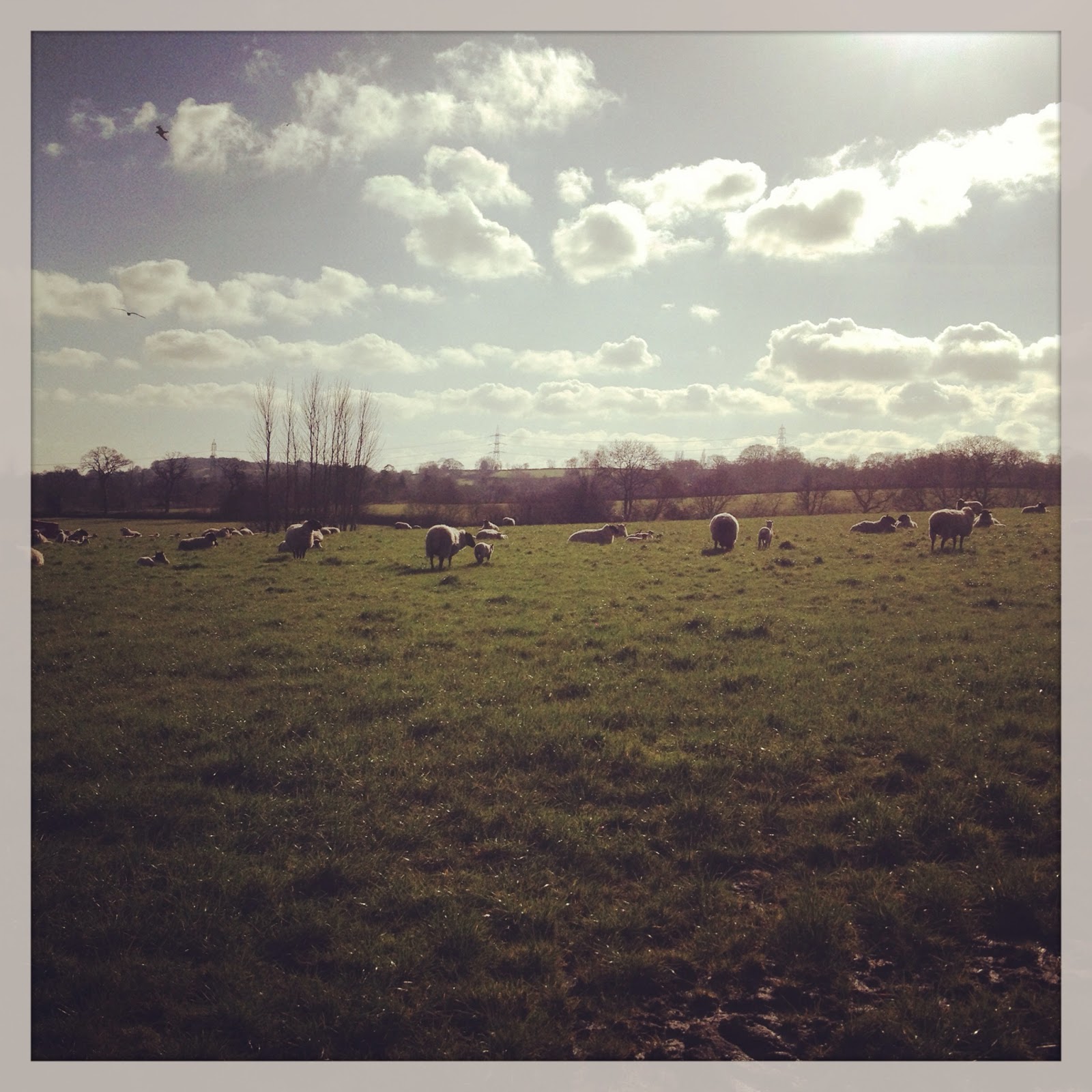
It is absolutely gorgeous outside today. Spring is here, even if there will be snow tomorrow. I stopped to chat with our neighbours who own the farm, and they were saying that last year the cows had been out for 2 weeks by this time! No sign of them yet this year- it's all sheep sheep sheep.

One of the best things about the spring is being able to enjoy wandering around the landscape looking at things. I did this a bit in autumn (and blogged about it) but it's right now, now that I've been here a few months, that I'm really starting to know where places are and how they connect up. Running has helped- experimental runs that end up following lanes and being a good 2km out of your comfort zone are great for landscape knowledge!
This got me thinking about building knowledge about the places where we live? How do we do this? How did people do it in the past?

Well, there's maps. Old ones and new ones. There's something really magical about the way maps work- putting down on a piece of paper not only where things are, but also what they look like and what they'll feel like for your body. You know when you see the contour lines scrunch up into an evil cluster that you will be gasping for air if you run up that hill (thanks Kate Bush). OS Maps are a pleasure, a treasure trove- hunting out the gothic writing that suggests there's something old and exciting right on that spot. But maps aren't just simple sheets of paper that you can whack in your pocket and use to find out where the nearest pub is. Maps are made by people- and people have ulterior motivations, passions and beliefs that structure how they draw out the land. OS Maps themselves are the product of the Ordnance Survey, a government sponsored project begun in the 18th century. The Ordnance Survey began as an act of colonial dominion in the aftermath of the Jacobite rebellion- a survey was made in 1747 to ensure that government forces would never be at a disadvantage in terms of knowledge of terrain. The entire country was eventually covered, and the official Ordnance Survey was founded in 1791: just in time for the Napoleonic wars. In the event of an invasion, these intricate maps would provide Britain's defenders with all the knowledge required to fight Boney's evil forces. And that's nothing compared to the politics behind medieval and early modern period maps, especially of the New World- literally carving out nations and ontologies on a piece of paper. Far more important to place Jerusalem at the centre of the world and claim all the unknown lands for Her Majesty Queen Elizabeth than to get a river in the right position.

Maps are perhaps the most formal way of noting what's where. Literally moving around maps the ground into your brain perhaps more effectively. You end up remembering where things are based on experience, rather than an abstract knowledge, although sometimes the two match up. For example, I know if I go to Shore Bottom, I will meet these two and their noisy friends:
 So it's really "the place where the loud collies live" in my head. Then there's the top of the hill- where you can see all the way across the valley.
 When I get back from my run or walk, I think through the places I've been. The markers I assign them are based on what I feel, what I experience, what I see. So, this is the place where the ford flooded really badly. That is the place where I went to sledge in the snow. All these things are linked to activities or happenings- that's the place where I tripped over into the ditch. The anthropologist Tim Ingold, quite some time ago now, developed the concept of taskscape- the landscape composed not of passive features, but of happenings, of doings (Ingold 1993). Incorporated into this is the idea of time- the taskscape transforming, the world around us changing, as we change the things we do in it. To that, I'd like to incorporate thinking as doing. Thinking though the world and our experiences of it create a series of task like impressions on our inner maps of where we go and what we do. Taskscape yes, but memoryscape more so. If you do the same thing in the same place, create the same memories and pass them on, the land around you becomes imbued with stories, happenings, doings and thoughts. Places become sites of storytelling, accumulating memories. While places in the past may have been caught and bound up and squodged into shape in maps, inside people's heads they were still composed of all the flotsam and jetsam of their lives. That's what makes place from space.
Reference- this is very easy to read and a real eye opener. I love it as much as I did the first time I read it in the first year of undergraduate study.
Ingold, T. 1993. The temporality of the landscape. World Archaeology 25: 152-174.
If you'd like to read more about the social context of maps, this volume is pretty good.
Klein, B. 2001. Maps and the writing of space in Early Modern England. London, Palgrave Macmillan.
One of the best things about the spring is being able to enjoy wandering around the landscape looking at things. I did this a bit in autumn (and blogged about it) but it's right now, now that I've been here a few months, that I'm really starting to know where places are and how they connect up. Running has helped- experimental runs that end up following lanes and being a good 2km out of your comfort zone are great for landscape knowledge!
This got me thinking about building knowledge about the places where we live? How do we do this? How did people do it in the past?

Well, there's maps. Old ones and new ones. There's something really magical about the way maps work- putting down on a piece of paper not only where things are, but also what they look like and what they'll feel like for your body. You know when you see the contour lines scrunch up into an evil cluster that you will be gasping for air if you run up that hill (thanks Kate Bush). OS Maps are a pleasure, a treasure trove- hunting out the gothic writing that suggests there's something old and exciting right on that spot. But maps aren't just simple sheets of paper that you can whack in your pocket and use to find out where the nearest pub is. Maps are made by people- and people have ulterior motivations, passions and beliefs that structure how they draw out the land. OS Maps themselves are the product of the Ordnance Survey, a government sponsored project begun in the 18th century. The Ordnance Survey began as an act of colonial dominion in the aftermath of the Jacobite rebellion- a survey was made in 1747 to ensure that government forces would never be at a disadvantage in terms of knowledge of terrain. The entire country was eventually covered, and the official Ordnance Survey was founded in 1791: just in time for the Napoleonic wars. In the event of an invasion, these intricate maps would provide Britain's defenders with all the knowledge required to fight Boney's evil forces. And that's nothing compared to the politics behind medieval and early modern period maps, especially of the New World- literally carving out nations and ontologies on a piece of paper. Far more important to place Jerusalem at the centre of the world and claim all the unknown lands for Her Majesty Queen Elizabeth than to get a river in the right position.

Maps are perhaps the most formal way of noting what's where. Literally moving around maps the ground into your brain perhaps more effectively. You end up remembering where things are based on experience, rather than an abstract knowledge, although sometimes the two match up. For example, I know if I go to Shore Bottom, I will meet these two and their noisy friends:


 |
| This is where I got stuck in brambles and had to be rescued. It looks so innocent now, but at the time it was NOT funny... |
Reference- this is very easy to read and a real eye opener. I love it as much as I did the first time I read it in the first year of undergraduate study.
Ingold, T. 1993. The temporality of the landscape. World Archaeology 25: 152-174.
If you'd like to read more about the social context of maps, this volume is pretty good.
Klein, B. 2001. Maps and the writing of space in Early Modern England. London, Palgrave Macmillan.
Friday, 16 November 2012
Pots Post: Looking at the Floor
This is a little bit of a soppy post. The "Pots" posts here are for things that are everyday, so I thought I'd start off with something that I do everyday. I look at the floor. I don't know if this is something unique to archaeologists (although my family certainly think so), but when I walk around, I tend to notice things on the ground. Of course, I love looking up at the sky, trees, buildings and not bumping into people, but the floor seems to draw my gaze more often than not. This odd activity has its perks, particularly at this time of year. You notice patterns and objects that other people step over: fallen leaves, strangely posed rubbish, prints in mud. You also avoid treading in dog poo and/or nasty puddles, or have a better chance of doing this.
I'm in Rome at the moment working at the British School (there'll be posts about this aplenty). Yesterday I snuck away from my desk and my work to clear my head in the Villa Borghese park. Here are some things that I noticed on the ground there, and thought I'd take photos of. My faithful old wellies are in a couple of the pictures- they frame my gaze as I look at the earth.

I noticed the horse shoes in this dried out mud, alongside the horizontal pine needles. The scuffing out and retainment of the prints reminds me of just how ephemeral the traces of passage can be. Some of these horseshoes were deep and pitted, while others had almost been swallowed up again by the dust. The idea of horses in such an urban setting is also quite appealing- these were well off the track of the carriage rides you see advertised in central Rome.

This was the first photo I took from the walk. I liked the bark chip on the floor, alongside the small number of leaves. So many leaves are still on the trees here in Rome, while at home in Devon the trees are almost bare, with the rooks' nests exposed in the branches. The single green leaf amongs the brown dead humus and man made bark chip stood out.

This is another example of fallen leaves- these tiny yellow and green pieces were flashes of colour on the path. So bright and tiny, yet arranged almost in a spiralling swirl entwined with darker patches of bark. The rotten leaves that had already fallen were dried out and grey, with tiny pices of stone providing a pointillistic effect, if you want to see it there.
I don't know whether doing this is a hangover from my experience of grown-up survey archaeology, or the remnants of hopes of discovery and instant fame from a childhood spent wanting to find Iron Age glory in the dust of parks in Hertfordshire and the sulking of enforced walks. Frankly, when it lets me notice things like these tiny compositions made from the interaction between people, animals and the world of the park, I'm not sure I care. The ground is as much a part of Villa Borghese as the stunning pine and cyprus trees, the lake with its' rowing boats, and the faux and real Roman architecture.
Do you look at the floor? Do you notice things on the ground? Do you think this is weird? Let me know what you think. I promise the next "Pots" post will be more prosaic...
I'm in Rome at the moment working at the British School (there'll be posts about this aplenty). Yesterday I snuck away from my desk and my work to clear my head in the Villa Borghese park. Here are some things that I noticed on the ground there, and thought I'd take photos of. My faithful old wellies are in a couple of the pictures- they frame my gaze as I look at the earth.

I noticed the horse shoes in this dried out mud, alongside the horizontal pine needles. The scuffing out and retainment of the prints reminds me of just how ephemeral the traces of passage can be. Some of these horseshoes were deep and pitted, while others had almost been swallowed up again by the dust. The idea of horses in such an urban setting is also quite appealing- these were well off the track of the carriage rides you see advertised in central Rome.

This was the first photo I took from the walk. I liked the bark chip on the floor, alongside the small number of leaves. So many leaves are still on the trees here in Rome, while at home in Devon the trees are almost bare, with the rooks' nests exposed in the branches. The single green leaf amongs the brown dead humus and man made bark chip stood out.

This is another example of fallen leaves- these tiny yellow and green pieces were flashes of colour on the path. So bright and tiny, yet arranged almost in a spiralling swirl entwined with darker patches of bark. The rotten leaves that had already fallen were dried out and grey, with tiny pices of stone providing a pointillistic effect, if you want to see it there.
I don't know whether doing this is a hangover from my experience of grown-up survey archaeology, or the remnants of hopes of discovery and instant fame from a childhood spent wanting to find Iron Age glory in the dust of parks in Hertfordshire and the sulking of enforced walks. Frankly, when it lets me notice things like these tiny compositions made from the interaction between people, animals and the world of the park, I'm not sure I care. The ground is as much a part of Villa Borghese as the stunning pine and cyprus trees, the lake with its' rowing boats, and the faux and real Roman architecture.
Do you look at the floor? Do you notice things on the ground? Do you think this is weird? Let me know what you think. I promise the next "Pots" post will be more prosaic...
Subscribe to:
Posts (Atom)