Pages

Tuesday, 26 February 2013

Bone: NOT mysterious Etruscans (vol.1)

In my first bone post I wrote a pretty safe introduction to the Etruscans, their world and the wonderful things they made. I alluded to a couple of inconsistencies in the way the Etruscans are presented in the modern world, and promised to address these later in another blog post. I've actually decided to go ahead and make this into a series for the blog- there are just so many to deal with!! The title for this post is inspired by perhaps the biggest Etruscan website on the internet- mysteriousetruscans.com Now, I have no problem at all with popular Etruscology. The website is actually pretty good! It has a tonne of pictures, some lovely guides to different tomb paintings at Tarquinia, and is a fun introduction to the Etruscans. But there are two things I find difficult, both on that website in particular, and in the majority of presentations of the Etruscans. I'm going to address the first one in this post, and the second in the next "Bone" post.


The first one? Clue's in the name. Mysterious Etruscans. It's a hook, a meme, a trope. It ends up with (I swear I'm not making this up) people alluding on Twitter to the Italian election results as being as mysterious and impenetrable as the Etruscans!!! It influences reconstructions of Etruscan life, like this rather sultry and spooky image above*. It also results in crazy, hysterical films such as The Etruscan Kills Again (L'Etrusco uccide ancora).


Why has this stereotype evolved? Well, as far as I can gather, there are four key features which make the Etruscans so supposedly "mysterious."


The first of them is the fact that the Etruscans are commonly thought to have just plain old disappeared. Roman action during the conquest of Etruria is conceived of as a cultural and physical genocide, with Etruscan culture dying out forever, leaving a tempting glut of so-called "lost" knowledge. It seems, however, that the Etruscans were actually absorbed into Roman culture, rather than wiped out. One of the most famous Etruscan artefacts, the Piacenza liver, used for the quintessentially Etruscan activity of fortune-telling, dates from the second century BC- long after the Roman conquest. It was (according to legend) an Etruscan haruspex or fortune teller who told Julius Caesar not to go to the Senate on the fateful Ides of March. Togas, gladiators, lituus staffs- all Roman objects with an Etruscan origin. However, it is in the Roman adoption of Etruscan objects, and interest in Etruscan culture, that I think the presentation of the Etruscans as mysterious begins- the Emperor Claudius commissioned a study of Etruscan religious belief, suggesting that by the first century AD, after a long period of assimilation, Etruscan and Roman identity had become one and the same, prompting interest in the recovery of the former. So, treating the Etruscans as mysterious has a long heritage!
Azande oracle
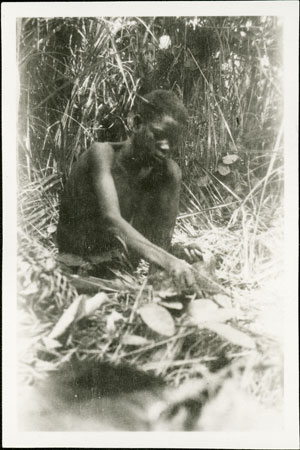
The second reason I suspect we think of the Etruscans as mysterious is both cause and result of the Roman interest in them: the connection between Etruscan culture and genuine mysteries- fortune telling and occult beliefs. This is what Claudius was interested in, and what lies behind the Piacenza liver. An interest in predicting the future is certainly not unique to Etruscans- folk traditions from all over the world demonstrate a shared interest in knowledge of the forces which seemingly control our lives. The supposedly extreme Etruscan dedication to religion has spawned both an academic literature focused on these "most religious of men" and a public perception of the Etruscans as shadowy fortune tellers, slicing up dead animals and watching birds, making obscure predictions and, most importantly, getting them right on the big stage (see the Caesar incident). When discussing Edward Evans-Pritchard's "Witchcraft, Oracles and Magic among the Azande" with my undergraduate social anthropology students, I always think of the Etruscans: the fascination with the future and lure of connections with the gods has a powerful mystique: the glamour of the Other is a powerful thing.


This Otherness is the third reason for the presentation of the Etruscans as mysterious. Developed out of the work of Hegel, Husserl, Lacan and Levinas, the Other is the opposite to the Self, or the Same. Etruria was always the Other- to Rome, and, prior to that, to Greece. The Etruscans were a source of disgust and fascination to both cultures- the two central sources which informed the Renaissance, and shaped our modern Western world. As heirs to the classical legacy, we have also inherited the biases of Greece and Rome: the Etruscans are firmly Other to their Same. Women dine with men, animals are not sacrificed but cut open to view the entrails, children do not know who their parents are- Etruria is presented as a topsy-turvy land of contradiction by both Greeks and Romans. The same sense of mystery and fascination visible in classical texts which speak of the Etruscans is continued both in popular and academic literature. The response to this is often a fascination with a people who appear far "freer" than their uptight, influential, contemporaries:this seems to be a central feature of interest in the Etruscans, an interpretation particularly visible in the work of D.H. Lawrence (on whom more another day).

Liber Linteus texts, image wikimedia commons.

The fourth and final reason that we think of the Etruscans as mysterious concerns the same classical texts that tell us how the Greeks and Romans felt about their neighbours. The Etruscans themselves were literate- yet almost their entire literary canon is lost forever. No Etruscan Hesiod, Homer, Plato or Euripides. No Cicero, no Ovid, no Virgil. By writing almost exclusively on linen books, Etruscan authors were almost certain to be burnt, reused or lost over time. The most extensive Etruscan language work in existence is the Liber Linteus- a selection of extracts from a linen book, used to wrap an Egyptian mummy now in Zagreb. There are inscriptions and brief dedications, but the lack of extended literature leaves the Etruscans without a voice in the modern world. Their language, a non-Indo European variant, has still not yet been fully translated, leaving the Liber Linteus only partially understood**. We are left with the fetishised vision of the Greek and Roman Other, and the material culture of the Etruscans themselves- and the former has built up its influence on popular perception over the centuries. Etruscan archaeology can, will and does demonstrate that the Etruscans were so much more than mysterious- but its first task is to overcome the classical biases which have become so deeply engrained in our modern cultural psyche.

* The figure of the woman "lifts a light" on the mysterious beings inside, while the figures are all focused on the viewer rather than their activities or companions. The whole image has the sense of a secret, exclusive party which the viewer is crashing!

** See L.B. van der Meer's Liber linteus zagrabiensis. The Linen Book of Zagreb. A Comment on the Longest Etruscan Text, published in 2007, for more on this.

Wednesday, 20 February 2013

Place: The Land of Ad Hominem

St James's Palace. Image: British Monarchy Society


This post isn't about pretty snaps of places I've been or where I live. Place posts should be about more than that. This post is about the world we live in. Not all of it, that would be impossible, and pretentious. It's about one aspect of modern society- more specifically, one aspect of the way modern society likes to argue and to comment. I suppose it is an inevitable place in which we've ended up, but I definitiely do not like it. This post has been brewing for a while, but a media/Twitter tsunami yesterday had me at the point of raging. Hopefully I've calmed down enough not to rant.

Hilary Mantel. Photo (c) The Week


So, yesterday, if you didn't already know, some remarks made by Hilary Mantel, one of the most important writers yet living, given at a lecture six days ago, were published. They commented on the hypocrisy of the press, the public interest in the monarchy and bravely considered the author's own reaction to meeting the Queen. They also made historical connections between current Royals and their (sortof) ancestors. So far, so good. What stirred up the press to outraged self-defence masked as defence-of-the-realm was a few comments on the public perception of the Duchess of Cambridge. It was very clear that these remarks were based on the way Kate is perceived, and were not comments on her personality or personal life: just her public persona. They were a central part of an argument about the continuing interest in and role of the monarchy. The attack was firmly on those who whip up that interest into obsession, with tragic consequences in very recent memory. The predators of the press did not like this exposure. Not at all. So they turned upon the author who gave the lecture, presenting her remarks as a vicious personal attack, reducing a well balanced lecture to a cat fight, and finally dragging in the author's weight and own childlessness as proof of her jealousy and vindictive nature. The Daily Mail were the first (and worst) offenders. They were quickly followed by other sections of the press, who began reporting on the media storm itself, repeating the same details over and over. Other groups, particularly on Twitter, rose to the author's defence. The PM got involved. It all got very silly, very quickly.

Some people, including the author of the Guardian's lead on the story, consider the ensuing fuss to be the result of paternal media trying to diminish a strong female voice to heap praise a conformist obedient role model. I think that they've missed the point: a man would not have got away with such a strong attack on the press either, and the gender argument would be being used against him. Male or female, the problem is that it has not been, and would not be, the words and argument under scrutiny. Instead, it is the speaker themselves. Their views, their points, their logic are all useless in the face of personal facts. Mantel is childless and overweight. In another context, David Cameron is out of touch and upper class. Ed Miliband is a champagne socialist. In yet another, more horrible context, the attacks on Mary Beard a few weeks ago were shameless examples of this, as are almost all works of internet trolls. The same phenomenon lies behind comments on the horrific events surrounding the death of Reeva Steenkamp: her beauty and the combination of disability and fame in the person who killed her have become central to reporting of the case, even though they are irrelevant to the arguments about what happened that night. It has become the person, and not the argument, which is under scrutiny. You hear this every day- try getting through half an hour of the Today programme without hearing this tactic employed. You will see it in the newspapers, see it on the TV, see it everywhere that debate takes place. It has filtered down to become everyday usage. And this is shocking.

Reeva Steenkamp. Image: Yahoo.

It is shocking because the use of a person's opinions, social position and identity against the logic of an argument is one of the most classic fallacies identified by critical thinking. It's known as "ad hominem"- taking a debate "to the man." The point is that it doesn't matter who the speaker is or what they believe- the cold hard logic of their case is what counts towards the strength or weakness of their argument. In the rush of post-structural desires to recognise biases, to be aware of our own subjectivity, to recognise the potential for prejudice, we have forgotten the centrality of logic to argument, the need to be critical, impersonal. Many of the people who were so offended by the attack on Mantel are those who have contributed most to the creation of this atmosphere of hyper-subjectivity. We have collectively made a world in which ad hominem attack is the norm. Now we have to live with it.


Tuesday, 12 February 2013

Pots: Actual Bleddy Pots!


Well, last week was pretty exciting on this 'ere blog. Due to a bit of shameless self-promotion, some of the great and good of the Twitterati kindly tweeted links to the blog and some lovely feedback too. If you are reading this this week, thank you so much! I tried to thank everyone individually on Twitter, but if I failed, or if you looked at this blog to check out my Richard III piece and are back for more, then THANK YOU VERY MUCH! This post was always going to struggle to be as exciting as last week, however...

Fun as dissecting TV archaeology is, it isn't actually what I do day to day. I did say when I started this blog that "Pots" type posts were meant to be about daily life. So, I thought I'd write about what more or less is the crux of my daily existence- my research on Etruscan pottery. Please don't stop reading. Pottery has a bad, bad reputation that it doesn't deserve. OK, grotty nasty British pottery does. Sometimes. And finding endless sherds of poorly made eroded yuk when digging isn't exactly an advert for the glamour of ceramics. Five years ago, I too would have turned off at the mere mention of a pot. Back then, they were for people who liked petrographic analysis (cutting pots into slivers to examine their chemical composition....not my thing). But it turns out that pots are a lot like men (or women, whichever you want to use in this metaphor). You can swear off them all you like, but it will turn out that there'll be one that's just right for you. For me, it was Etruscan bucchero pottery. You can see me grinning in the picture like a loon in the Athens Archaeological Museum next to their sole case of bucchero- never mind the marble sculptures, I want black shiny Italian pots. This is on my honeymoon as well, just so you know how crazy I am about these pots. There are some other very nice Etruscan things in the case too- a Villanovan hut urn and Chiusine canopic urn, both for cremation burials. But back to the bucchero: the black colour is produced by a careful process of firing- heating the pots so that they set. By controlling the amount of oxygen, and burnishing the clay, you could recreate the shiny, luscious effect of bronze in (much cheaper) clay.


I don't really want to talk too much about bucchero, although it's great. I want to talk about pots themselves- what do we do with them? And what are they for? These are two really basic questions that drive my research on some particularly elaborately decorated Etruscan pottery. One of the things I'm really interested in is how pots themselves shape and twist your body into certain positions in order to use them. Usually, it's your hand, arm and mouth that get involved, with fingers put in all sorts of places. The pots, the inanimate objects, have the agency and power to enforce your usage of them in a particular way. Well, to strongly encourage you to use them in a specific way- the endorsement of that method by your social group does the rest. To illustrate this, I gathered together a gang of modern day pots (including glasses) and had a play around with what they made my body do.


The first two were quite easy. They were both made of glass- a small water glass and a pint glass. You'll have to excuse my continued vapid expression in all these pictures. The small glass only required me to wrap a single hand around it, and no thought at all to control the flow of liquid. The larger glass was heavier and more difficult to use, but still easily controllable with one hand. I'd imagine that a large pint glass would be very tough for a child to use- requiring the use of both hands and a technique to control the outflow of liquid into the mouth.


The next two pots were a bit more demanding, although still both made of glass. The first one was a tankard with a strongly formed handle. You couldn't really pick it up without coming up against the handle in some way. The most natural way of using the vessel felt like putting all my fingers into the handle space and wrapping my thumb around around the body of the vessel. Lifting the glass like this required my whole arm to move in an almost straight line, rather than just bend at the lower arm- a completely different motion from the first two glasses. It's interesting- I don't like using these glasses, but  my husband loves them and will choose them ahead of any other type of container in the cupboard. The second glass I tried is a bit of a funny one- it's meant to be a wine glass, but is wider and has a low foot. It demands (from me anyway) a twist in the hand. My ring finger and little finger are focused on the stem and base, while the two fore fingers and thumb wrap around the bowl. It looks convoluted in the picture, and I suppose I could just pick it up by wrapping my fingers all the way around the bowl- but that just doesn't feel secure, it doesn't feel right. Whether that comes from the pot or from me, I don't know.


The final pair of pots were actually made of clay- two different types of mug, which are really the only type of drinking vessel that's made of clay that I could find in the house. The first one is a posh wedding present mug- it keeps the large volume of a vessel designed to deliver lots of liquid, but tries to show off with a handle which is actually pretty demanding. The handle is just too small for me to put all my fingers through- and I don't have big hands. My little finger is forced out, poking into the air or clinging to the body of the mug. When the mug is full, I can't really lift the mug with one hand comfortably- there's pressure on my index finger, which, particularly when the contents are hot, is not very pleasant. The second mug is my favourite of all the vessels I tried- it's huge, fits loads of liquid, and has a handle which is much larger and more comfortable to use. However- the handle is still a little small for my hands, and it is still easier to use two hands and cup the vessel.

The pots that I played with were all pretty relaxed in their demands on my hands, although a couple certainly pointed to particular ways of holding. If you compare these to a Victorian teacup, or an Attic Black Figure Kylix, a style of drinking vessel used in Etruria, you can see just how lazy my pots are.

Image from bettyannharris.blogspot.com

Image via wikimedia commons


This process of playing around with pots has been fun- but it's serious too! Objects structure our lives in all sorts of different ways- this computer controls how I use it, my chair controls how I sit on it! I'd love to know what you think about objects as active agents in modern and past lives.

Disclaimer: this approach is entirely phenomenological- based on experience and perception. I'm going to post in more detail about this style of approach in the future- it certainly isn't perfect. 

Tuesday, 5 February 2013

Stone: Joking Aside: Kings, Car Parks, and the Future


The man himself
It feels like most of the country watched "The King in the Car Park" yesterday. A significant proportion of those also watched the press conference by the University of Leicester team earlier. The archaeological/academic griping was gentle after the press conference ("well, I'd like to know a bit more about the DNA"/"it would have been better to hold on three months until after peer review"/"shame about the University hierarchy cashing in on such good research"- for a good summary of these concerns, have a look at Mary Beard's excellent blog A Don's Life. After the documentary, it felt (on my Twitter feed anyway) as if the negativity had risen to fever pitch. I suspect there are a LOT of other archaeology blogs also putting out a post-mortem of events today. So, here are my thoughts on a spectacle that has exposed a huge amount of the tensions in modern archaeological practice, and which has been both a fantastic opportunity and a crashing disappointment. I've divided them into two camps: the press conference, and the programme.

The Press Conference

1) The whole bloody thing was incredibly exciting. It appealed utterly to the four-year-old inside me who just wanted to find old stuff in the ground. I would like to think that it inspired a new generation of children who will want to become archaeologists. And this wasn't just for kids- huge numbers of people were interested and emotionally involved with the outcome- it was an amazing platform for archaeological science.

2) The archaeologists at the press conference dealt brilliantly with this. While frustrated by the slightly overblown wa-wa speeches from the Vice Chancellor and Registrar trampling over good research, in realistic terms I think this is unavoidable. Any university would have done it- they'd be stupid not to. And while it isn't a realistic expectation, this will be a huge vehicle to induce students to apply to Leicester, in the vain hope they will get their mitts onto this type of research. You never know, maybe they will. Anyway, back to the press conference. A lot of people seemed to think it was drawn out, too long. They just wanted a one word statement and some pictures for the paper. I would say that this was a masterstroke from the scientists involved. The proceedings were organised like a series of very small conference papers- the researchers did NOT want you to know the answer without understanding HOW they came up with the answer. By taking the media and those watching through the process of archaeological investigation, osteoarchaeological examination and (the weakest bits as no mention of archives/process) genealogy and genetics, the way professional archaeology works was brought out to the nation. Yes, they didn't peer review- but the entire conference was, in many ways, a massive form of peer review. Had the research just been submitted (as I understand it will be) to Antiquity, there would have been 2 reviewers. As it is, the entire country reviewed their work. Based on the press conference, I was excited about the longer programme.

The Programme

1) The biggest issue I had with the programme personally was the way that the excellent (and very presentable) archaeological staff were sidelined to make way for a very limited selection of historians. Yes, it is a medieval discovery, but the archaeological information was what was central to the case. We did not need to float around Bosworth field showing Victorian engravings of medieval warfare- it would have been far better to talk to those who worked on the human remains from the battle of Towton project (you can follow the work of the Towton survey at http://www.towtonbattle.com/ or you can buy the book on the skeletal remains from Oxbow, "Blood Red Roses: The Archaeology of a Mass Grave from the Battle of Towton AD 1461" here). I am not anti-historian, either. The individuals using historical information were not held to account- who said that, and where, and when? There was a lot of talk about Tudor propaganda, but the sources were never sifted and sorted accordingly. No clarity, just a load of waffle with the diggers shoved in the back room.

Skull from Towton

2) While the diggers and excellent academic staff (who were incredibly presentable and very competent and clear, as they proved in the press conference) were shoved to one side, two people were brought to the fore. One was completely inappropriate, one was an utter victim of Channel 4 production values. The presenter, Simon Farnaby, took the wrong line throughout: he went for comedy. Considering the amount of bad jokes floating around on social media all day, and the potential for po-faced dullness, I can understand where he was coming from. But he wasn't the focus: the dead king was, or should have been. The shots of Simon at home with his (lovely) dalmatian were filler at best, and patronising rubbish at worst. When he began spouting cultural evolutionary cliches about the violence and cruelty of medieval society compared to the modern world, I was spitting fire (see my last post on Dead Babies and Poggio Civitate). People wanted information, not self-reflection from someone who I think was supposed to represent the "everyman" reaction. The other central character in the programme was Philippa Langley, from the Richard III society. The Twittersphere seemed almost united in its damning of her- whipped up by cruel editing and vicious exploitation from Channel 4. Yes, to many people it might seem ridiculous that she was upset by seeing the remains of Richard. But she had created a vision of this long-dead King in her mind, and it was falling down in front of her eyes. Before the dig, her opinion was as valid as anyone else's. Afterwards, she was forced to change it. We all know how unpleasant an enforced change of opinion, particularly a strongly held opinion, can be. If that wasn't enough, she was made to look like a madwoman on television. Nobody needs that. Yes, I too enjoyed watching the occasional snigger from the scientists, but I was generally impressed that Ms Langley was included to such a high degree- it spoke very well for the inclusivity of the project as a piece of public archaeology. It also introduced a potentially very interesting conversation about the relationship between emotion and archaeology, as observed by Lorna Richardson on her excellent twitter feed last night.

3) The brilliant parts of the programme, which haven't gone unnoticed by those who viewed it, were all connected with the research staff. When the osteoarchaeologist admitted putting a mattock through a skull, there was a big mutual grin on the faces of archaeologists everywhere- we all know that if you want to find something delicate, get the mattock out. It's utter sod's law. The reality of human bone treatment- cardboard box for one, please. The incredible skill of facial reconstruction. These were the real highlights. If only there had been more explanation to make these aspects stronger. My husband commented (he's the opposite of an archaeologist- he's a builder) that he felt like the academics wanted him to understand but the producers were determined that he wouldn't. That about sums up the problem. The isotopic analysis of the bone was a particular case in point- people wanted to know HOW the process told us the individual had eaten marine fish, not speculate and move swiftly on.

I could go on to dissect the programme in detail, but I'm not going to. The conclusion that I want to draw from all this is that there is hope for the future in archaeology. The amount of people drawn into the conclusions of yesterday show that. These people do not deserve to be patronised, or conned with weird cartoons and freaky music. They want knowledge, they want information, and they want contact with real research. This is where the role of people like Dig Ventures and Past Preservers becomes so important. The former give people the chance to do professional archaeology for a weekend, and understand the real process of research. Incidentally, this is what (to an extent anyway) Time Team did too, and what university projects SHOULD be doing. Past Preservers have perhaps an equally important role to play, one which any archaeologist lucky enough to be placed in the public eye should also contribute to. We need someone to stand our ground with production companies- to just say no to waffle and blurb, to demand that the audience are treated as thinking adults, to place research at the centre of television. This is an issue that goes far beyond the King in the Car Park documentary. Getting it right in public is one of the most important issues for modern archaeology. In a world of cuts to research and heritage, we need to justify our existence. And the way to do it is through the initial joy and excitement of discovery, but also through the dissemination and sharing of cold hard knowledge.

What do you think about the Rich III saga? Do you agree about the future of archaeology? Check out the Archaeologists Anonymous project blog on the side bar for more on the latter topic.

As an aside, this makes the Poggio Civitate dead baby blow up look like a storm in a teacup. Phew.

Thursday, 31 January 2013

Place: Mexico, Belize, Guatemala

This is more or less a picture post, a what-this-archaeologist-did-on-her-holidays type of post. As I blogged about previously, I ran away over Christmas to the hot sunny lands of Central America. It all seems a hundred million lightyears away as I sit in my study surrounded by snow, but I did go! It was real! And I had a fantastic time. The exact right balance between archaeology (for me), beach time (for my long suffering other half) and nature (for both of us). And food... the food was incredible. I won't even start on the amounts of tequila based fluid consumed as daily cocktail intake.


The view from my house last week...

I love to travel. I actually think it's pretty important. There's nothing like a good culture shock to make you remember the old chestnut that the past is a foreign country- and probably more foreign than any foreign country you can just hop to on a plane! Watching other people live completely different lives, and knowing that the way they go about their day will keep going, long after you go back to what's "normal" for you, is pretty amazing. The whole world gets on with its respective business, while I sit and write this in cold Devon.


...it seemed a world away from Flores, Guatemala, where I am here...

Palenque, where the world didn't end.


Skulking around looking at the floor....
It's also bloody lovely to get away archaeologically. We honeymooned in Greece, so I knew a whole load about all the sites we were seeing. The result of this was I got cross with incorrect signs, and stomped around museums gloating over the amounts of bucchero and Etruscan made material while my husband sighed and took pictures. Mayan archaeology is something I know very little about- so I just lapped up the sites, didn't fuss over the signs, and only had one Hermione-Granger moment when the guide started talking about the Pope's crozier as a sign of spiritual dominion (there's a long history to the blimmin' thing, which seems to have started life as an ETRUSCAN lituus or magistrate's staff. Eurgh).

It was particularly special to be visiting in time for the supposed "Mayan apocalypse" of 2012. Needless to say, it didn't happen. What did happen was a lot of hippies showed up at the site of Palenque, where we were staying, tried to stay up chanting and taking ayahuasca all night, got drenched by a vicious thunderstorm which showed what the gods thought of them, and then were looking utterly miserable with bloody noses and soaking wet maxidresses the next day. I sniggered unkindly, but seeing the dedication these people had did make me realise the power of these ancient places for them- who was I to laugh? I felt pretty guilty about laughing the night before at the figures running through the pouring rain falling over in wet robes due to the amount of mind altering substances they'd consumed. It was funny though, honest.


Phil looking sick at Bonampak!


The amazing murals at Bonampak- weirdly reminding me of Etruscan tomb paintings in brighter colours...
My favourite site was (predictably) the quietest and least visited we went to. It's called Yaxchilan, and to get there you have to travel in a little boat an hour down a river. There were spider and howler monkeys, living in almost intact jungle, and the best archaeology was 300m up and well worth the climb. I also loved seeing the murals from Bonampak, although my husband was feeling very ill that day and did not appreciate being dragged up the steps to see them. He does say it was worth it now though.


Yaxchilan
A very excited me on the boat to Yaxchilan!


The final site of our tour was Tikal, which we visited in the dark in time for sunrise. I can't really describe the experience more than to say (banally) that it was truly magical. As we visited very close to the solstice, the sun rose directly over one of the temples to strike us viewers in the face. We also got some fabulous photos of the wildlife...

Sunrise at Tikal


Spider monkey at Tikal- this incredible photo, like all the pictures from this post in which he doesn't feature, was taken by my husband Phil- thank you :)
So, that was my trip- worth not blogging for a few weeks eh??

In all seriousness- I think going away was one of the best things I could have done. In fact, I'm plotting a humungous getaway for when I finish my PhD. Dependent on when and what happens afterwards, I'd really like to have another fantastic, culture shock escape. Maybe a little more wildlife/seaside than this time though- it's only fair on hubby. I'm thinking Nepal and India? We'll see.

I hope you liked the photos, and I would say to anyone considering going to Central America- do it. Go tomorrow and book the flights.

Where are you travelling to next? Where was the best place you've been? How has travel changed you? As an archaeologist/academic or as a person?

Tuesday, 15 January 2013

Bone: Dead Babies and Poggio Civitate

In the summer of 2010, osteoarchaeologist Sarah Kansa was making a detailed examination of hundreds of bags of mixed animal bone, the result of many years of excavation at Poggio Civitate. This site, excavated since 1966, is one of the most significant non-funerary sites in Etruscan archaeology, most famous for the stunning architectural terracottas used to decorate its central complex. It sounds like the start of a novel, or an action/ horror film, as while Sarah was working through the bone remains, she made a discovery- a tiny fragment of human bone which would become the centre of what, to an Etruscan archaeologist, has become a media storm. In typical fashion, I had left Poggio Civitate 2 days before Sarah made her discovery- heading home from excavation a week early to get married. When I returned last summer, one of the first things I did on my first lab day was nonchalantly wander over to Sarah's workspace to look at the group of tiny bones, which Sarah had identified as those of an infant or infants. Their fragility invoked in me a completely unprofessional ethnocentric response connected to human tragedies in the present for me- the loss of a child and the emotions involved. At the time that I first saw the remains, my cousin (and friend) was 8 months pregnant- imagining her and her partner's response, and that of our family, to that precious life ending soon after birth was horrific and disturbing.* 

View of Poggio Civitate looking beautiful on a summer's day. 

The same reaction which I instinctively felt on seeing the remains is what lies at the heart of what happened when the site director, Dr Anthony Tuck presented the discovery at the American Institute of Archaeology Annual Meeting a week and a half ago. The context of the find, excavated from the Orientalising period workshop building (more information about the workshop in this article by Tuck and Nielson, published in 2001, here ), alongside animal bones and debris, led Tuck to suggest that, possibly, this infant was disposed of without a formalised burial. He went on to raise questions about the status of infants in Etruria, asking whether it could have been possible for stillborn or neonatal infants to be regarded as non-persons at this period. ** The potential for mass exploitation of the emotional reactions I experienced when seeing the remains was picked up by media sources, recognising the potential for a good story- originally by NBC Science , then by Live Science and then by the Daily Mail. The latter's coverage was particularly rotten, even by their standards- describing the site as Roman rather than Etruscan and filled with sensationalist overexcitement and righteous outrage at the barbarism of the past, both features which, while present in the previous articles, were at least slightly understated. ***

 The central problem with the coverage, as astutely pointed out by Dr Kristina Killgrove, was the cultural Darwinism inherent in these posts- we in the present treat our infants well, so we can be nicely horrified by past cultures, and vilify and judge their decisions and choices. Yet, at the same time as the Poggio Civitate infant remains were being used as a bolster to our present superiority, a story was breaking in the UK that demonstrated the continuity of practice in the disposal of infant remains as non-persons. This story from Scotland outlined the facts that a crematorium in Edinburgh had been routinely misleading parents about the cremated remains of their children. The Mortonhall Crematorium told parents that no remains would be extant after cremation for them to scatter, as infants are too small to produce ashes for secondary burial. What happened was that ashes were produced, and then buried together in a mass grave over a period of 45 years. Although the placement of the grave was in a "Garden of Rememberance," the remains of neonates were treated distinctly differently from those of adults, and denied individual identity in death. The Mortonhall scandal is not alone: this article by Lynn Morgan outlines another issue of infant status in the modern world- the disposal of foetal remains as medical waste and curation as biological specimens, while there have been two cases of babies found in association with rubbish this year- one still alive after a 50ft fall down a rubbish chute and one found dead at a rubbish dump in Scunthorpe. Whether by distressed and unprepared parents or uncaring authorities, infants are still being treated in a different fashion to adult human remains in the modern world- and this is just in the UK alone! While it is great to see a site you work at in the international news, it would be even better if that news coverage was tempered by sensitivity to the otherness of the past and honesty about practices in the present.


* Her baby was born on 11/08/12 and has been from the start a very happy and healthy little boy. Look! Isn't he gorgeous? By the way, I'm not saying that the mother (s) of the Poggio Civitate infant (or infants) didn't grieve over their babies- but I doubt they felt exactly the same way a modern mother would.

** I don't want to get into the interpretative debate about the context of the bones in detail- it would take this post away from a point about present-centrism, and I'm neither an osteologist nor a forensic taphonomist. Tuck's original presentation presented one hypothesis of disposal alongside rubbish, while Killgrove's response (see link above) suggested a secondary disturbance as responsible for the presence of the infant remains in the workshop. I am tempted to think there is room for a third point of view- looking not, as Killgrove did, to the later Roman world, but north to the European Iron Age. JD Hill's "Ritual and rubbish in the Iron Age of Wessex" presents a different way of thinking about deposition- recognising the incorporation of ritual into the disposal of animal remains, seeming rubbish, and humans. A recent article by Adrian Chadwick further develops the nuances of this argument. If the lines between ritual deposition and chucking away rubbish are recognised as blurred and complex, the infant remains from Poggio Civitate can be seen in a different light. The systematic destruction of Poggio Civitate's Archaic complex certainly points to a hyprid form of deposition at a later point in the site's history.

*** There is a debate here to be had about public, open access archaeology and sensationalisation, but that is another can of worms altogether- and one that, in the wake of the tragic death of Aaron Swartz, is also getting a lot of attention at the moment. Suffice to say, the public deserve better than incorrect, sloppy archaeological journalism as exemplified by the Mail. I know plenty of archaeologists who would be more than happy to provide such assistance as needed! 

References (in addition to articles linked to above)

Chadwick, A. M. (2012), Routine Magic, Mundane Ritual. Towards a Unified Notion of Depositional Practice. Oxford Journal of Archaeology, 31: 283–315. 

Hill, J. D. (1995). Ritual and rubbish in the Iron Age of Wessex. A study on the formation of a specific archaeological record. Tempus, Oxford.

Tuesday, 8 January 2013

Pots: Time Off and 2013

I cannot believe it has been almost a month since I last wrote on this blog. I would love to say that it's been a manically busy period, I've got loads accomplished, finished my PhD and got a million journal articles accepted but that would be a big fat lie. In fact, I have been away. I brought articles and a work book with me, but I didn't read them. I lay on the beach, and visited some amazing archaeological sites in lands far far away. They pushed me right out of my comfort zone- I knew nothing about them, and very little about the people who made them. I just gawped along with all the other folks standing looking at them.

The reason that this is a Pots post is that I am starting to think that time off should be an everday thing. BECAUSE the gawping and sunning time that I have just spent has been one of the most productive times in my life. I was getting pretty tired and run down by the end of last academic term- with no holiday apart from 3 days off in March since my honeymoon, which itself ended up very stressful, I had no idea how much I needed a break. I turned off my twitchy Twitter spidey senses, stopped looking at emails, and just absorbed the world for 3 weeks. It was blissful. By the end of the first week, problems that I had been worrying over constantly were suddenly small and solvable- I can just ask this person for help, I can just apply for that. By the end of the second, I had a massive breakthrough with my PhD thesis- I suddenly realised exactly what I wanted to conclude, and what I had learnt. Just before I went away, my wonderful supervisor told me that I was "banging on the door" of having my work completely sussed. All it took were 2 weeks away to burst through the door and come out the other side elated.

So, I am thinking that time off, time away, is perhaps one of the most important aspects of academic practice. Before my dog died, I was very good at this- I had to make space for 2 hours each day to walk, with no gizmos or phone or anything, just me, him and our feet moving and thoughts flowing. All the positive breakthroughs of my time away have shown me that this is something my brain is missing. So, I am going to try and take time more regularly to just switch off- stop tussling and worrying over tiny issues, making them bigger instead of smaller. It's like my mind just needs a bit of time to process, before it can come up with an answer- unconscious thought whirring away in the background. I didn't realise how important this space and time would be, until I wasn't letting myself have it anymore. Everyday time to reflect, time to empty my mind and refresh myself. I think this can only make my work better, and certainly my work-life balance better. So that's my New Year lesson, I suppose. 2012 was a year that started with heartbreak and ended with burnout. I'm not going to do that in 2013. I'm going to do things aside from work that I love- running, yoga, and volunteering. I've just volunteered to work in two different museums, which, now that I'm not teaching any more, I have time for. Hopefully they will stop me getting bogged down again, and provide a little more regular respite from the Etruscans in my head! (Caveat: I don't think there are actual Etruscans in my head. They are definitely metaphorical, just so you know I'm not crazy).

What are your plans for 2013? What do you do to take time off? Is it an important part of your academic life? Do you have past people in your head?


PS- a sneak peek from my trip away to Mexico, Guatemala and Belize. I will blog about this in more detail another day... but you can see why I was glazed over with amazement... maybe mindblowing archaeology should be a prescription experience?